 Pam Strayer | Wine Business
The nation’s most prestigious wine grape grower organization, the Napa Valley Grapegrowers (NVGG), gathered in early November for their two day annual conference, Rootstock. Breaking with the tradition of covering many topics at Rootstock, this year the group featured just one subject–weed control.
The topic has stirred controversy in recent years.
A week later, Napa Green, the county’s prominent sustainability program, announced it would require its members to phase out conventional herbicides, including Roundup, by 2026, offering growers technical and financial assistance to support the change The program has 25 current members and 44 others who are in transition. Together they collectively farm 7,000 acres of vines.
The growers’ educational gathering was held amidst growing consumer concerns that glyphosate based herbicides, featured in front page news (in recent court cases and ongoing studies), inhibit soil health and affect human health. In Napa, some consumers then began asking vintners if they used the herbicide, which put the topic on some wineries’ radar.
“The Napa Valley Grapegrowers have never shied away from a difficult topic or an interesting topic for discussion within the industry,” said NVGG board member Dave Whitmer, the county’s former Ag Commissioner.
As the NVGG said in describing its Nov. 6-7 event on its website, “as consumers’ and lenders’ perceptions around herbicides shift, there is mounting pressure across the wine production chain to adapt farming methods…. as Napa Valley growers continue to strive for viticultural excellence, employing innovative practices is paramount to continuing to increase quality and sustainability in our vineyards.”
The 100 attendees heard from a total of eight speakers over the two days, including data analyst Sarah Ferguson, CEO and Founder of Ruetd, a data analytics consultancy, who shared county statistics.
Speakers from the U.C. system included Scott Steinmaus, PhD, Head of Plant Sciences, California Polytechnic State University, San Luis Obispo, on Monday, and, on Tuesday, weed control specialist John Roncoroni, Weed Science Farm Advisor, Emeritus, UC Cooperative Extension, who worked extensively in Napa County. Roncoroni presented a broad survey of current weed control approaches on Nov. 7 in a continuing education session.
Speaking on Nov. 6 in favor of glyphosate free farming were Brian Lilla, whose film Children of the Vine documented health concerns, and Ivo Jeramaz, Vice President of Vineyards & Production at Grgich Hills Estate, who manages 360 acres of Regenerative Organic Certified vineyards in Napa. In Jeramaz’s talk, he called weeds “companion plants.”
Soil Health, Human Health
After the United Nations’ cancer risk experts labeled it a “probable human carcinogen” in 2016, consumers and media began questioning Roundup’s safety. Concerns increased when, starting in 2018, three Bay Area juries ordered Roundup’s maker, Bayer (which had acquired Monsanto) to pay billions to plaintiffs who said the herbicide caused them to get a form of cancer called non-Hodgkin’s lymphoma (NHL). The court cases made front page headlines around the world and Bayer’s stock dropped in half over the ensuing 5 years.
In the grower community, conversations have focused more on Roundup’s impacts on soil microbial health, vineyard longevity and costs of alternative weed control, including under vine cultivation.
The NVGG event presented in-depth information and a variety of viewpoints, including a deep dive into the history of weed control, a community filmmaker’s cautionary perspective questioning the herbicides’ use (especially its impact on child health), and, in a for credit lecture on the second day of the event, a weed control expert’s survey of a broad array of weed control tools.
(Videos of the first day’s presentations are available online for viewing by NVGG members).
“One of the things I love about our system is the freedom that growers have to make individual choices.” said Whitmer, in his opening remarks.
He went on to ask the attendees, “Are you making decisions that are going to improve the quality of your soil? Are you making decisions that are going to be the best decisions for you and your family, and for your workforce and for your neighbors and the community in Napa Valley?”
A Deep Data Dive
Ferguson presented charts showing that between September of 2022 and August of 2023, 40 percent of planted Napa wine grape acreage was not treated with conventional herbicide.
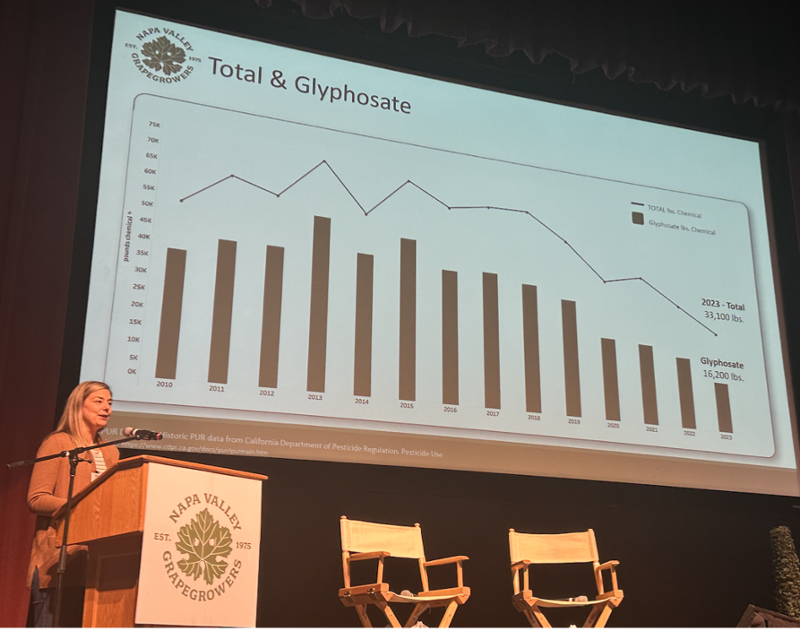
Ferguson also presented a chart using data from 2010-2023 (which she called the modern era), that showed glyphosate herbicide use peaked in 2013.
In the 12 months from Sept. 2022 to August 2023, use reached its lowest level since 2010, she said. During that period, she reported that 16,200 pounds of glyphosate based products, typically Roundup PowerMax (an industrial strength version for professional applicators), were applied.
Ferguson said the weedkiller was applied solely in under vine areas, not row middles. While its use has declined, it is still the most commonly applied pesticide in the county, she said.
(For the sake of comparison, statewide in 2021, wine grape growers in California applied more than 518,000 pounds of glyphosate on 270,000 acres out of a total of 550,000 total acres, according to the California Dept. of Pesticide Regulation’s 2021 pesticide use report.)
Since Roundup is unpopular with some consumers, a number of growers have switched to glufosinate ammonium–one popular brand is Lifeline–so if they are asked if they use Roundup, they can say they don’t.
According to Department of Pesticide Regulation statistics, at the same time that glyphosate usage declined, glufosinate ammonium sprayed vineyard acres in Napa rose from 7,596 in 2017 to 9,731 in 2021–a 28 percent increase.
A History of Herbicide Use in Vineyards and Agriculture
Steinmaus gave a masterful and in depth history of weed control history and trends, reminding the audience of the invention of the seed drill, the toxicity of sulfuric acid era, how mechanization changed weed management–”it brought our workforce from 75 percent on the farm down to 20 to 25 percent on farm”–and traced the introduction of now old school, nefarious chemical compounds in the 20th century–many of which are now banned or highly restricted after research revealed their toxicity and newer products replaced them.
He showed a slide of Napa’s pesticide use in 1975 which documented 2,586 pounds of the powerful herbicide paraquat (now banned in the EU but still legal under U.S. EPA’s federal restrictions) used on a total of 11,124 acres in Napa county. (None is used in Napa today).
The year 1982 marked the first recorded use of glyphosate in the state’s pesticide use report, he said. By 1989, the systemic herbicide glyphosate was the most popularly used chemical, applied to 39 percent of acres, while by then paraquat was used on just 5.5 percent. By 2009, as systemics supplanted contact herbicides, glyphosate was applied to 55 percent of the acreage, he said.
His deep dive into the past also spanned a quick summary of the history of pesticide regulation, the impact of Rachel Carson’s landmark book Silent Spring, and public health concerns that led to the passage of the Clean Water Act, Clean Air Act, the Endangered Species Act, and the Occupational Health and Safety Act.
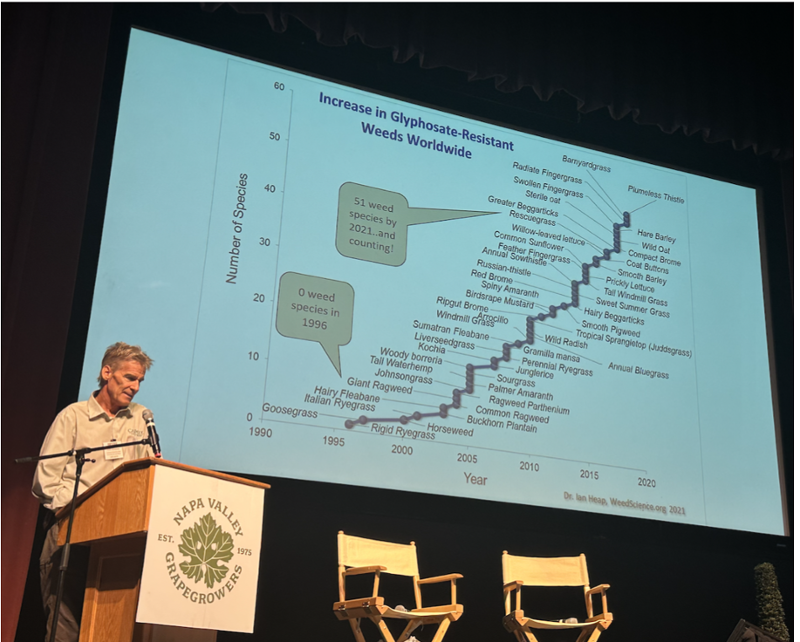
As glyphosate’s popularity grew, herbicide resistance began to increase over three decades, he said, showing a slide of resistance progressing to include 51 glyphosate resistant species in recent years. Manufacturers have tried to develop products with other modes of action, but so far, none succeeded in replacing Roundup.
Consumer Concerns
Weeds were not the only organisms to resist glyphosate.
Consumers began to read widely publicized reports, on social media and in the news, about glyphosate testing from nonprofit, anti-glyphosate activist groups, including CalPIRG and Environmental Working Group.
Once consumers became concerned about glyphosate in foods, marketers saw an opportunity to create new “free from” labeling, mainly for foods, but a few in wine, Steinmaus said, showing the example of a SmartVine marketing ad.
When tiny amounts of residues were found in vineyards that had been organic for decades, organic vintners pointed to rainwater as a possible contaminant since the U.S.G.S. published studies in 2014 that rainwater was contaminated with glyphosate and in 2020 published research showing that 66 of 70 U.S. streams and rivers tested had glyphosate residues.
Human Health and Cancer Risks Debated
Steinmaus (whose brother is an MD and MPH and adjunct faculty at U.C. Berkeley’s School of Public Health) dismissed some epidemiological studies about glyphosate, saying he found the evidence lacking.
He attacked a 2019 meta analysis from adjunct professor Luoping Zhang, Ph.D., a prominent blood cancer researcher from U.C. Berkeley’s School of Public Health, that found a 41 percent increase in NHL cancer risk from those with the highest levels of exposure to glyphosate.
“Anybody who says that it causes cancer for sure is a liar,” he said. “And anybody who says that it does not cause cancer is a liar. So it’s a very, very complicated story.”
Meanwhile 2023 front page reports featuring CDC data showed that 87 percent of the 2,310 people whose urine it tested had glyphosate residues. (Experts surmise that most non agricultural workers are primarily exposed to it by eating conventionally grown, grain based processed foods.) A third of those tested were children.
While dietary exposures can be minimized by eating organic, a 2023 study focused on field spraying and residues is prompting growing concern over farm workers and their children’s exposure levels in areas where herbicide is widely sprayed on food crops.
“New research from the U.C. Berkeley School of Public Health shows that childhood exposure to the world’s most widely used weed killer, glyphosate, is linked to liver inflammation and metabolic disorder in early adulthood, which could lead to liver cancer, diabetes, and cardiovascular disease later in life,” said Cal in a 2023 press release. The study is a long range one, centered on families in the Salinas Valley.
The Community Conversation: “Understanding the Public Perspective of Herbicides”
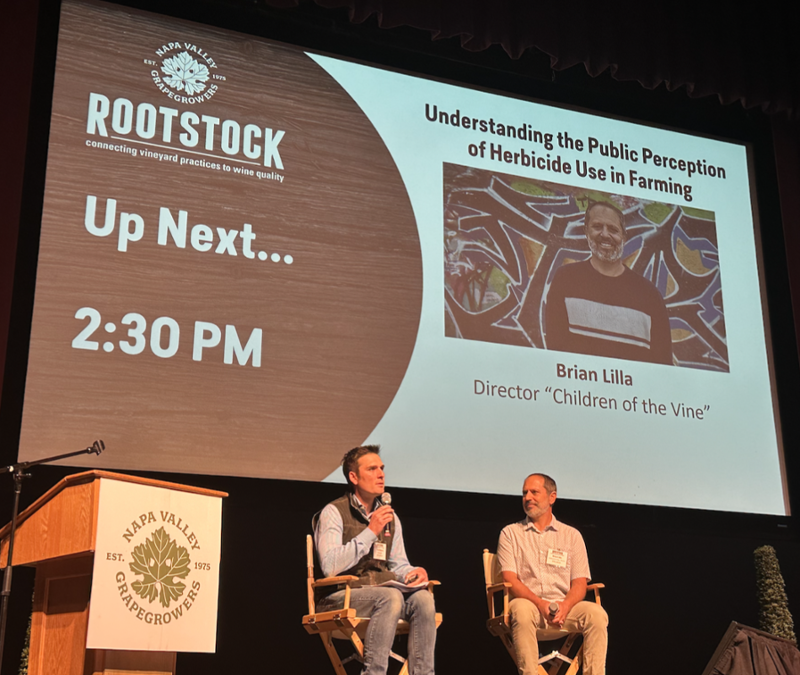
Next up was a dialog with NVGG board member and vineyard manager Caleb Moseley interviewing Napa resident and documentary director Brian Lilla, whose film “Children of the Vine” presents the case against glyphosate with interviews with doctors, organic wine grape growers and conventional farmers.
Lilla is currently conducting community screenings in California and across the country and said he was interested in screening the film for the growers organization.
The film features two certified organic grape growers in northern California, including vineyard manager Frank Leeds, Vice President and Senior Advisor, Viticulture and Farming at Frog’s Leap in Napa and Ted Lemon, President of Littorai in Sonoma.
A new, hard-hitting documentary on the 2018 Johnson case, Into the Weeds, a feature length film from a Canadian director, will debut on U.S. streaming channels on Dec. 8. It features leading medical experts, plaintiffs and their lawyers and evidence that Monsanto knew glyphosate could cause cancer, a fact that was revealed in the court case discovery process. (It was Monsanto’s failure to put a warning label on Roundup that led to plaintiffs’ awards.) Consumer awareness is expected to grow following the film’s public release.
After seeing Lilla’s film earlier, NVGG finance committee member Tom Davies, president and managing partner, V. Sattui, and Dario Sattui, founder and visionary, together decided to transition to organic farming and certification on their 343 acres of estate vines, saying it was “just the right thing to do.”
More than 6,000 acres of Napa’s 45,000 acres of vines are currently certified organic or in transition to organic certification.
Soil Health: A Wine Business Case Study
Closing out the first day, Jeramaz presented soil health and financial data showing the advantages he experienced as a long time organic grower who has recently been certified Regenerative Organic. He emphasized that soil is a living system and characterized what many call weeds as “companion plants.”
His data showed that the approach he uses, with a focus on enhancing soil microbial health, is low cost and effective in promoting soil health and vineyard longevity.
Weed Control Options
On Tuesday, Roncoroni’s talk “Integrated Weed Management – Identification, Control, and Innovative Alternatives” covered dozens of tools in the weed control tool kit, providing a well rounded set of options.
Napa Green Town Hall to Air Community Discussion
A week after the NVGG event, on Nov. 14 Napa Green, the county’s sustainability program, announced it would require members to phase out the use of conventional herbicides, including both glyphosate and glufosinate ammonium, by 2026.
It will hold a town hall event on the decision Dec. 7 in St. Helena.
To see a full list of members visit: napagreen.org/participating-members
About Napa Green: The Napa Green 501c3 is a global leader in sustainable winegrowing, setting the highest bar for sustainability and climate action in the wine industry. Napa Green facilitates whole system soil to bottle certification for wineries and vineyards, and provides the expertise, boots-on-the-ground support, and resources to continually improve. Learn more at https://napagreen.org/participating-members/.
Anna Brittain
Napa Green
+1 805-636-3329
email us here
Visit us on social media:
Facebook
LinkedIn
Instagram