 Pam Strayer | Wine Country Geographic
So many people in the wine business debate whether or not it is profitable to farm organically.
With only about 3 percent of wine grape vines in California (and the U.S.) certified organic, the U.S. has been quite far behind its counterparts in France, Italy and Spain where 18 percent of vines are currently or in transition to organic certification. Markets for organically grown wines there are booming and even major corporations have realized they need to diversify their portfolios to include at least one organic brand. Jealous of the increased 25% margin on organic grapes and wines in the south, more than 300 low-end Bordeaux producers have recently sought organic certification hoping to increase profits. Coops in the south of France are finding organics an on ramp to better returns.
While vineyard management companies can charge the same to farm organically (Matthiasson, for example, in Napa) or add an additional 30 percent (as in both Napa and Sta. Rita Hills examples), confusion continues to reign.
So it was quite a pleasure to attend four days of this year’s inaugural six day Napa Thrives event, and find the day on IPM featured a variety of approaches to reducing or eliminating chemical use in the vines with organic examples.
Wight Vineyard management kicked off the day with a boots on the ground session at the 80 acre Oak Knoll vineyard Clif Family recently purchased. Much of the conversation was about products–attendees wanted to know what products you can use and how effective they are compared to conventional ones.
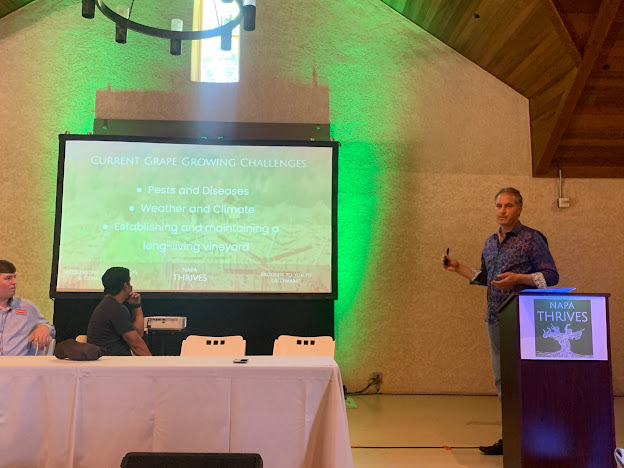
Later in the day, in the main speakers hall in the elegant event center barn at Charles Krug, more presentations fleshed out different scenarios.
One of the most important was given by Ivo Jeramaz, Winemaker and Vice President of Vineyards & Production, who farms 5 vineyard sites in 5 Napa AVAs. He oversees 365 acres of organic vines, all of which have been certified organic since 2006.
Ivo gave this talk illustrated with these slides which I thought should be shared with a wider audience, and, in agreeing with me, he graciously allowed me to post them here, along with a transcript of his remarks.
So dig in. Some very good data – not from academics, but from a real farming operation that operates from the Carneros and Yountville to American Canyon, Rutherford and Calistoga.
The reason we farm organically is to lower costs and enjoy high profits, eliminate pests and diseases and avoid applying glyphosate or Roundup.
Today in the Napa/Sonoma area we are facing unprecedented problems. The farming system we use (regenerative farming) can help to deal with some of these other issues.
LONGEVITY
Vines can last 60 to 80 to 100 years.
Today the average Napa Valley vines are taken out after 20 years.
That’s a tragedy, because only vines over 20 years old can truly produce some great fruit.
3 MAIN ORGANIC FARMING OBJECTIONS
When you talk to a professional and ask them why they do not convert to organic, we hear three things–expenses, pests and disease control, and lower yields. I’ll address every one of these concerns with our own experience. This is not a theory. I don’t care for theories. I care for practice. These are our practical data and numbers.
ORGANIC COSTS AND PROFITABILITY
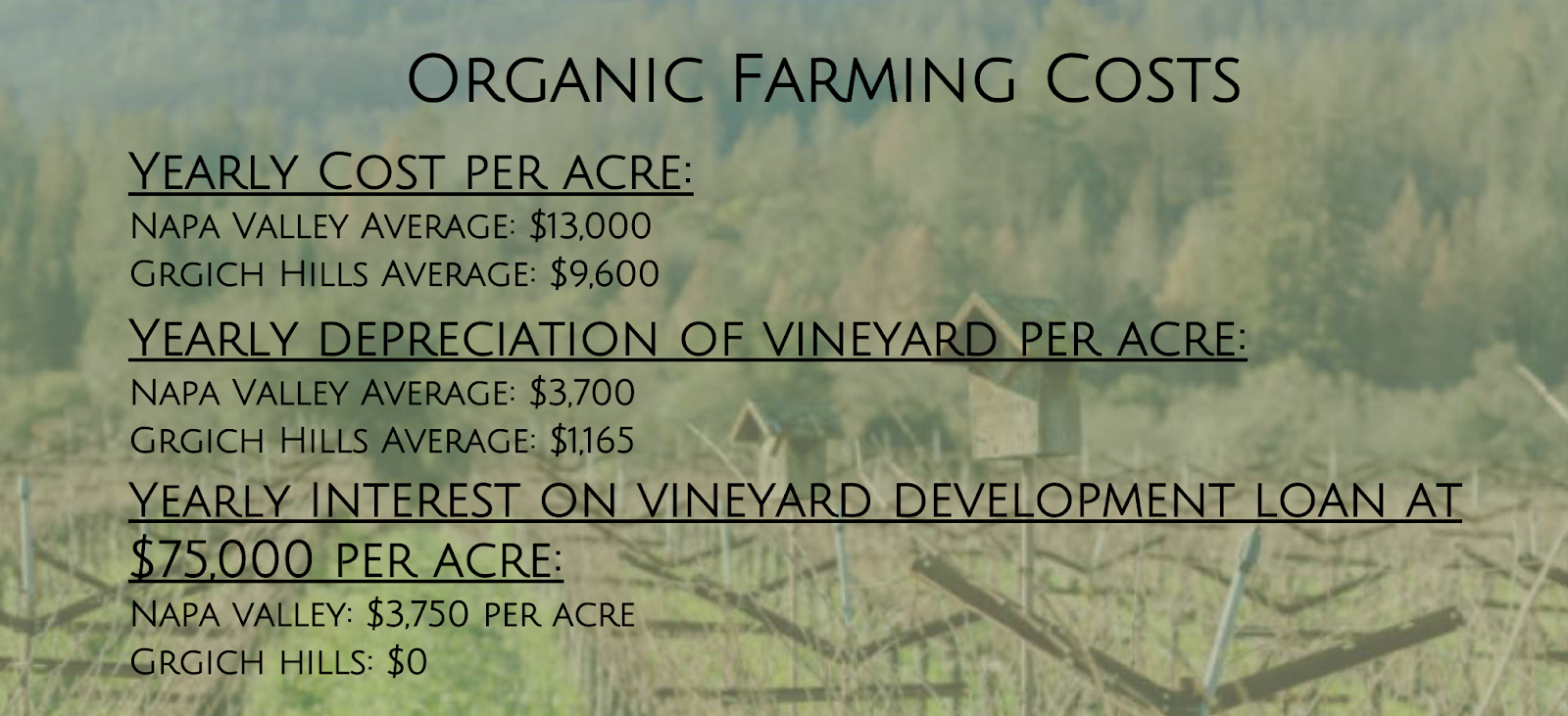
In Napa Valley, the yearly cost of farming a vineyard per acre is astronomical–$13,000. Our friend from Monterey loves this number, because his costs are half, but this is Napa Valley.
Napa Valley average cost per acre, per year is $13,000. At Grgich, where we are doing organic, biodynamic and regenerative farming, it is $9,600.
That doesn’t include depreciation. Those of you that own vineyards know what I’m talking about. Depreciation is huge.
You spend today around $75,000 to replant a vineyard. Divide that by 20 years and that’s your depreciation–$3,700.
At Grgich Hills it’s $1,100 because our vineyards last much longer and we depreciate over 40 or 50 years, not over 20 years.
Then there is interest. Because of how we farm, we have cash–which offers some advantages. We don’t take out loans to get money from the bank. We use our own money. We don’t borrow money from the bank.
If a winery doesn’t have $10 million sitting around, they have to borrow. So $75,000 per acre, plus another $3,750 per acre per year. Compare these results.
So, it is not true that organic farming is more expensive and that it’s only reserved for wealthy Silicon Valley owners who can afford to lose money every year.
Any business has to be profitable, especially in agriculture. Most of modern agriculture is not profitable, and we have to change that.
PESTS AND DISEASES
The second misconception of organic farming is there is no way to manage pests and diseases.
Down in Carneros, five or six years ago, we had to spray up to 15 times to control mildew. Today, it’s down to seven times and we can eliminate the need for many sprays through this kind of farming.
For you folks who manage grapes, when do we stop worrying about mildew? When sugar in the berry is about 12-15 Brix.
Just imagine if the sugar of the sap of the vine is 12-15 brix, the vine becomes resistant to mildew and also mealybugs.
This is called passive resistance–you move the food source for these pests and you starve them. I know some of you will say this is not true, but it is true. How do we achieve higher brix in the whole grapevine? The answer is, we have to increase the rate of photosynthesis, again through enhancing microbial diversity and population in the soil.
But why do people remove so many vines today? Viruses.
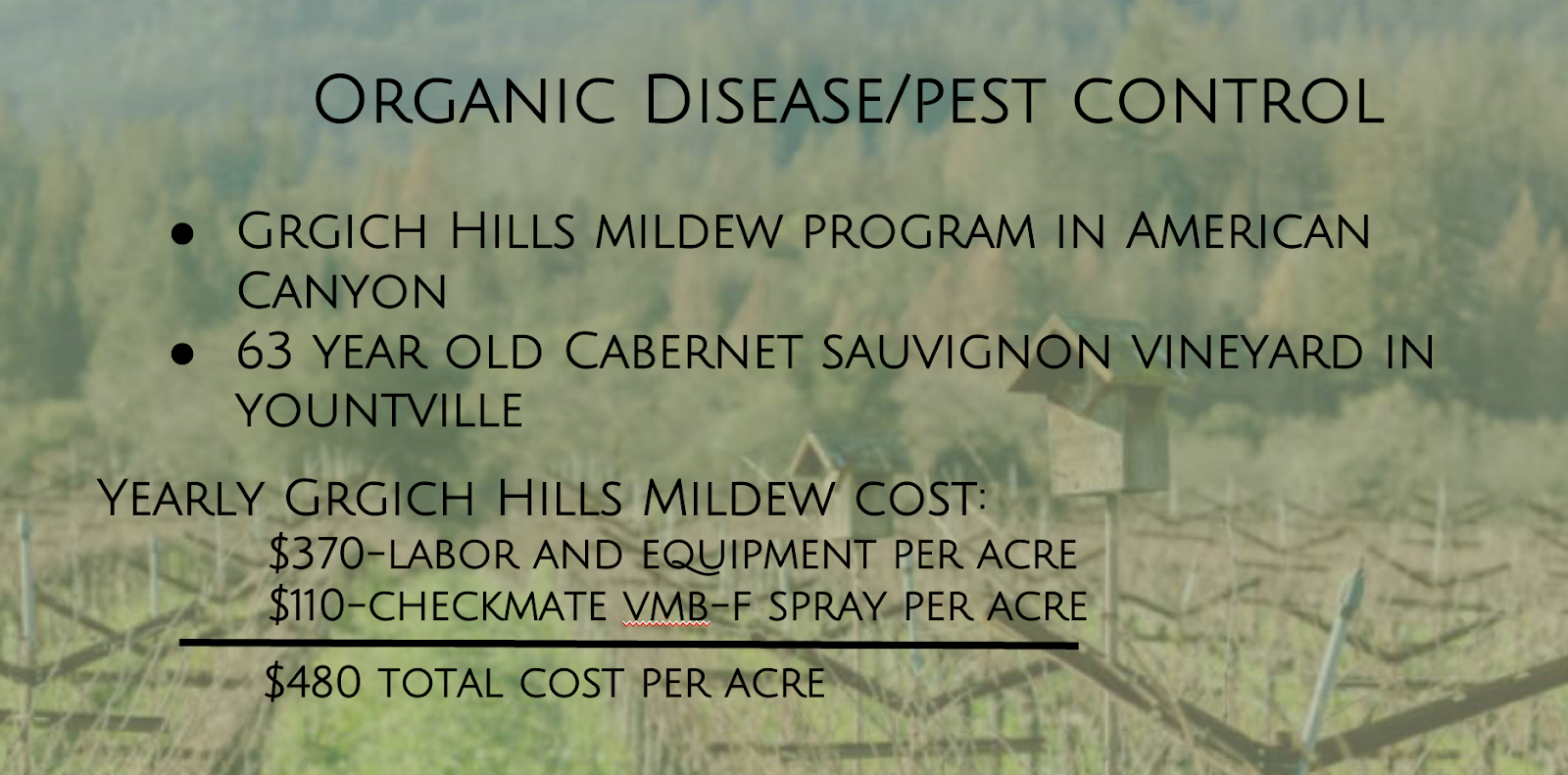
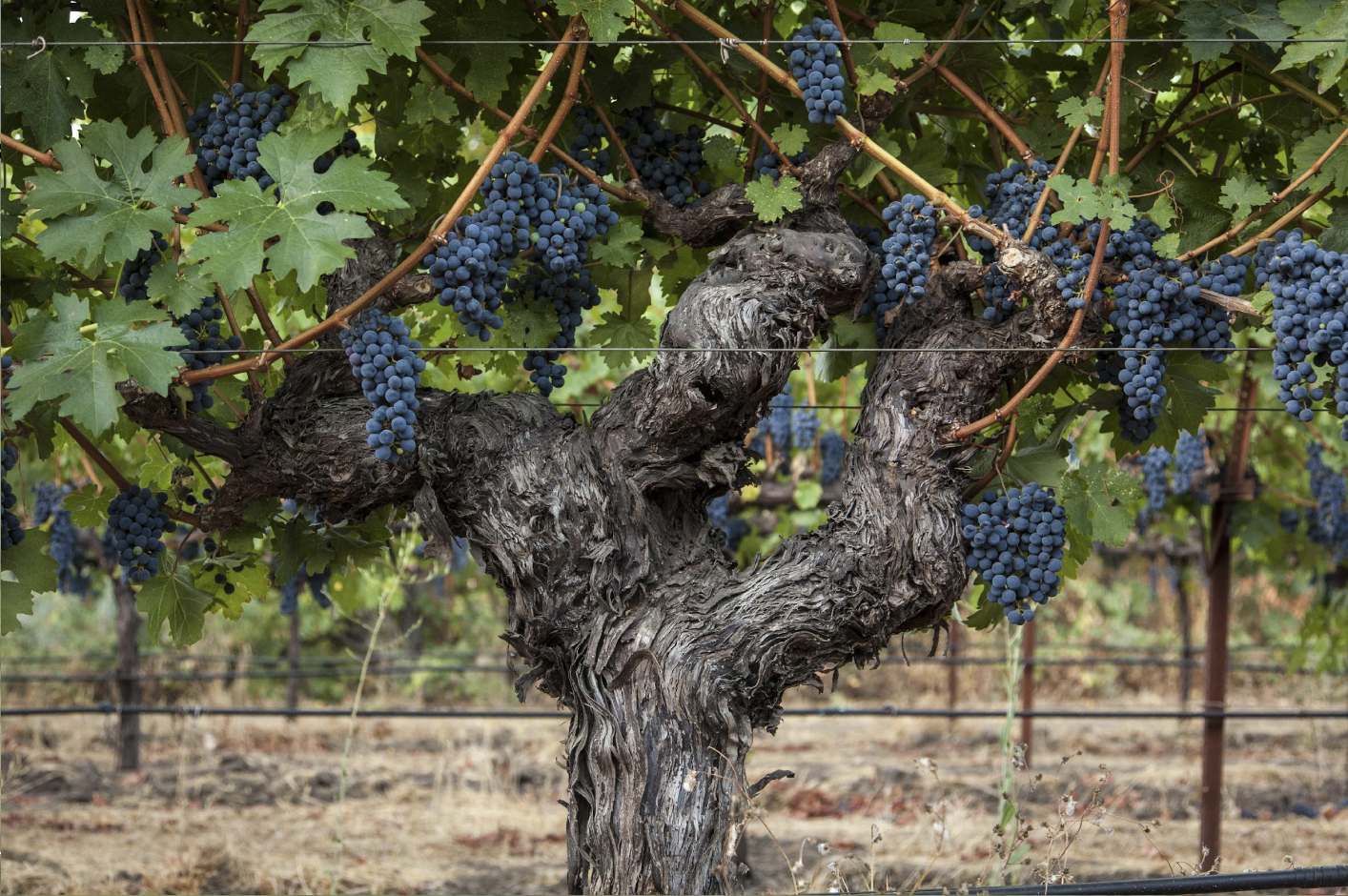
Yet in our Yountville vineyard, which is infected with a virus, we manage to harvest with a good yield – 3.25 tons per acre on average, over the last few years, and the vines have lived for 63 years.
When you look at the vineyard in September, you will find out that 40% of the plants have red leaves. We can see that, we measure that, and we know we have leafroll. Yet plants are very healthy, with good yield, and, needless to say, the best quality in Napa Valley that we have.
So why do we not pull that vineyard? Because while these plants are infected, they still produce a quality yield while being 63 years old and infected with a virus.
We cannot create health through sterility and human control. We have to create health through microbial biodiversity and natural methods.
MILDEW COSTS
We paid $370 in labor and material to control mildew. Add to that a $110 spray for vine mealybug pheromone disruption, so $480 per acre is the total cost per acre for mildew and mealybug control.
YIELDS–LONGEVITY MATTERS
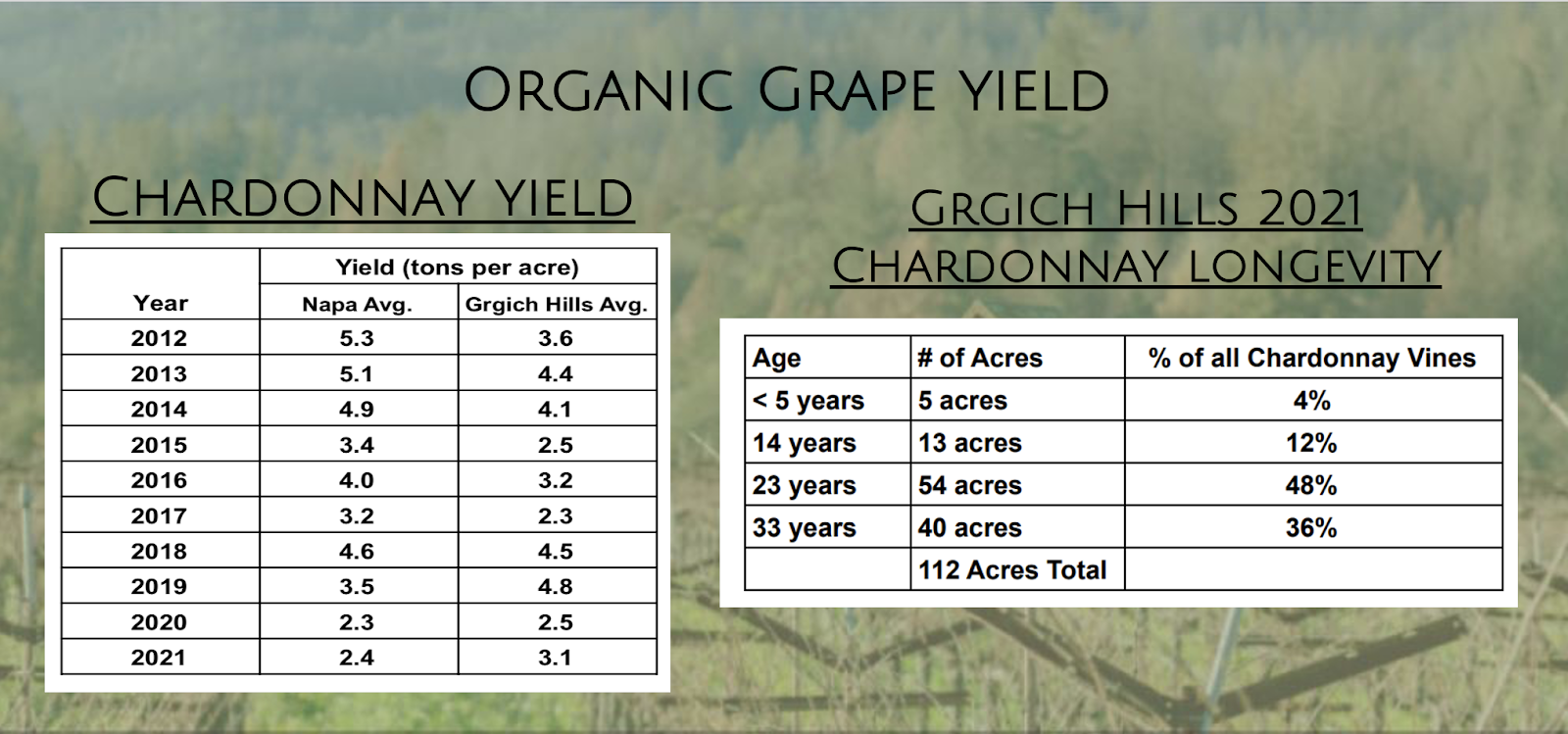
It is interesting to look at the average of the last five years.
If I average all these yields, Grgich is 3.4 tons per acre versus 3.2 tons per acre for the Napa Valley average.
Breaking this down further, and looking at vine age, you can see that out of 112 acres of Chardonnay, 48% of our vines are 23 years old and 36% are 33 years old. There’s no need to take these out. They are producing fruit and there is no drop in yield.
WHY WE DON’T USE ROUNDUP HERBICIDE
I want to talk about another of the excuses. You say you cannot farm organic more or less, because you cannot give up glyphosate or Roundup. People say, “It’s too expensive or impossible to handle weeds.”
First of all, what is for most people, a weed, is to us, something that makes a vineyard beautiful. We like weeds. I’ll explain.
The major problem with glyphosate is not necessarily that it’s poisoning everything. It’s classified as an antibiotic, and that means it’s killing microbes in soil, which we so dearly need.
It’s a chelating agent. Chelation is the binding of nutrients. Glyphosate has the ability to grab manganese, zinc, and iron, and hold them tight. Plants cannot access them. They are not available for plants. So basically, you’re starving your grapevines, because they can’t get to those nutrients.
The history of glyphosate is interesting. In 1964, it was patented as a chelator to remove chemicals from pipes. That was glyphosate then. Then in 1974, it was patented as an herbicide. Then in 2010, it was patented as an antibiotic.
CULTIVATION COSTS
In October, the first thing we do is plant a cover crop, and after the first rain, within two weeks, the new cover crop is sprouting. At that point, we can handle five inches of rain in a day–our soil is like a sponge.
Then we let the cover crop grow. Typically in a normal year, by the end of January, our cover crop is two or three feet tall.
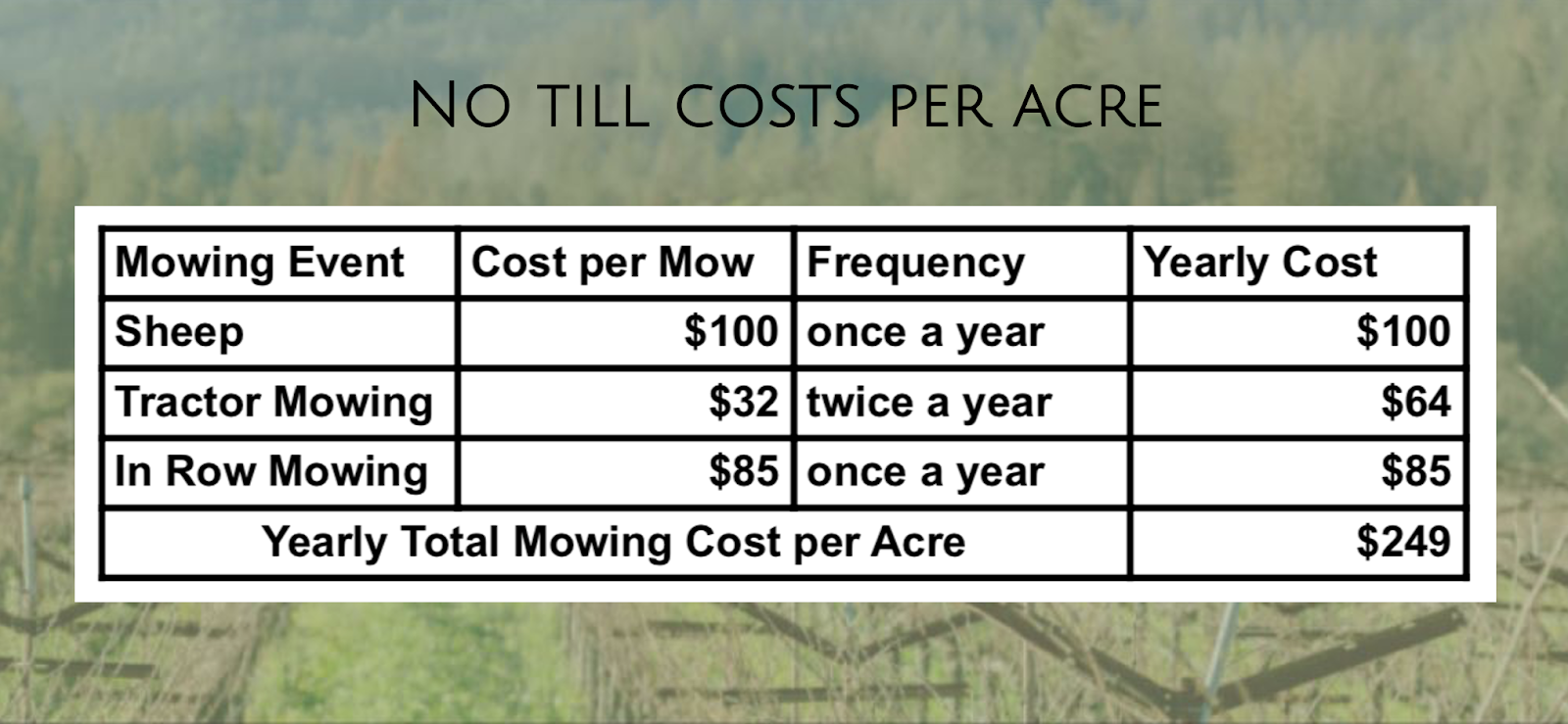
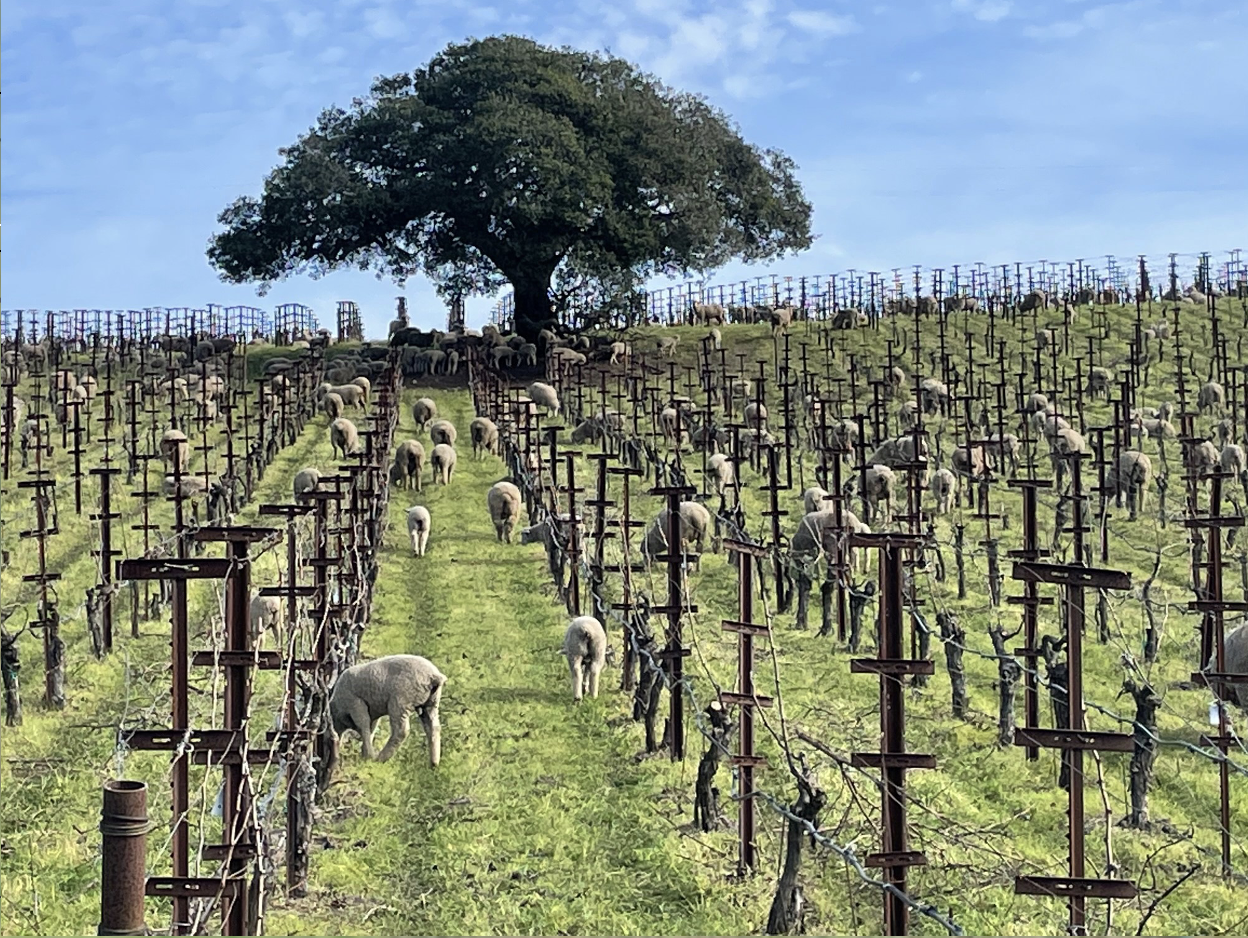
Then we bring in sheep. If you live in New Zealand, the sheep owner brings the sheep in and they pay you for the grass. Here in Napa Valley, it’s the opposite. You pay them for their sheep to eat the best grass in Napa Valley.
So the cost to us is about $100 per acre for sheep.
We let the sheep eat about only 50% of grass. As we learned in high school, photosynthesis creates carbohydrates. When we graze only 50%, we allow the grass roots to create the exudates that microbes feed on in the soil. So the cover crop feeds the microbes. This is symbiosis between plants and microbes.
If you overgraze, that can limit the effectiveness of the cover crop to produce root exudates and feed the microbes.
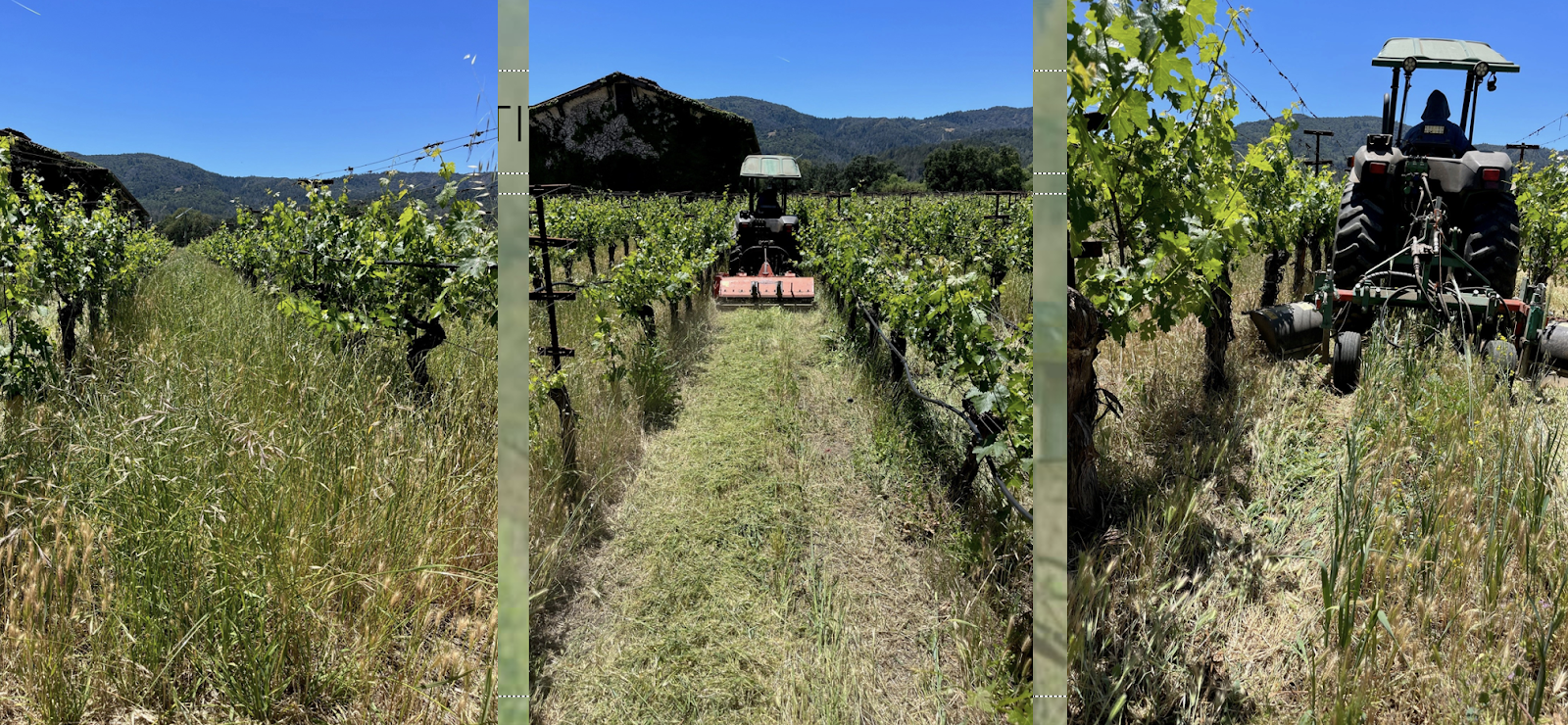
Then, depending on the year, we have to mow the grass two or three times. It cost less than $250 so that’s it. That is all the costs for handling grass.
We mow and mulch. If you follow this guy on the tractor, you will see he is leaving two inches of mulch that is the cut down cover crop and grasses. Why is this important?
On a 90 degree day, if you measure the surface temperature of the bare soil, it will be 150 degrees. Biology dies at 110 degrees, so a bare soil sitting in the sun will lose all life a few inches down.
At that temperature, you kill all the microbes. So there will be no more microbes.
WATER
Secondly, all the water in the first few inches of soil is evaporating. When surface water evaporates, more moisture is brought up by the capillary action of the plant and evaporated again. This is how we lose precious soil moisture.
So it’s a myth that clean cultivation saves water.
In our system, mulching lowers the natural ambient soil temperature a few inches down. If it’s 90 degrees outside, the soil under the mulch will be maybe 86 degrees.
SOIL HEALTH
We always knew that we needed healthy soil for the best grapes and for longevity.
We are a family owned business. We want to keep it independent for a few more generations.
Many farmers look at only a three to five year business plan. We’re looking 50-100 years into the future for our business plan.
When we started farming, we knew that we had to produce high quality grapes. Without high quality grapes, there’s no high quality wine. And we just discovered that contrary to popular belief, you can save money and farm responsibly in agriculture.
Basically we have to change our mindset.
How do we enhance soil organic matter, through managing cover crops, sheep and microbes in the soil?
At Grgich, in order to enhance organic soil matter we plant a cover crop and add compost every year. It took us 15 years to gain a 1% increase in soil organic matter. This is too slow.
My misconception was that healthy soil produces healthy plants. Actually, it is quite the opposite. You need to have healthy plants as cover crops, and you have to cover the soil all year round, because not growing plants in your soil will reduce the carbohydrates that feed the microbes.
Microbes are the bacteria and fungi living near the roots of plants. We stopped tilling our soil to enhance the population of fungi which, through fungal digestion, builds up soil organic matter much quicker. Do not destroy fungi, because they create humus which is extremely beneficial.
Since we became “lazy famers,” (since we do not mow our vineyard rows) we now have quadrupled the amount of insects–including ladybugs– that are feeding on the mealybugs. Yet some people say, “Oh my God, these guys have not done their job because the vineyard has weeds in it and looks wild.” But we are increasing the health of the soil.
So besides increasing microbial diversity and the number of microbes, I can prepare food for plants in the form of biostimulants and foliar sprays. That is better versus ionic nitrogen, phosphorus, and potassium additions people add to their soils. In moderation, these sprays can help keep the plant growing healthy and strong and encourage it to use the nutrients that are already in the soil. This helps make the plant less reliant on our sprays and more reliant on the already present nutrients in the soil.
Just imagine, because of great plant nutrition and health, the grapevines will produce a much thicker waxy coat called a cuticle on the berry. This provides extra resistance against mildew and possibly smoke taint. So by improving the health of microbes and potentially doing some foliar sprays, some pests will not be as big of a problem. You’re making it harder for pests.
In our business, we are growing grapes not just for brix–but for the secondary metabolites–phenols, anthocyanins–that we want to make great wine. It’s these secondary metabolites that also generate the healthiest crop. They are good for our health and also good for the quality of our wine.
About Napa Green: The Napa Green 501c3 is a global leader in sustainable winegrowing, setting the highest bar for sustainability and climate action in the wine industry. Napa Green facilitates whole system soil to bottle certification for wineries and vineyards, and provides the expertise, boots-on-the-ground support, and resources to continually improve. Learn more at https://napagreen.org/participating-members/.
Anna Brittain
Napa Green
+1 805-636-3329
email us here
Visit us on social media:
Facebook
LinkedIn
Instagram