But there’s still a lot of confusion about what organic farming is. Particularly, how it differs from biodynamic, regenerative, or any of the other many certifications popping up on wine bottles.
“I’ve been fielding a lot more questions recently about certifications and carbon footprints,” says Marika Vida, a wine consultant and educator whose clients have included Wines of Argentina, Wines of Provence, the Ritz Carlton, and Laurent Tourondel Bistro BLT Market. “We need to get better as an industry at communicating what certifications mean and pointing out certifications in stores and on menus.”
For clarity and perspective, we reached out to producers pushing sustainability beyond the bounds of what seemed possible or realistic for commercial enterprises even a handful of years ago.
Land to Market: Focus on the Soil
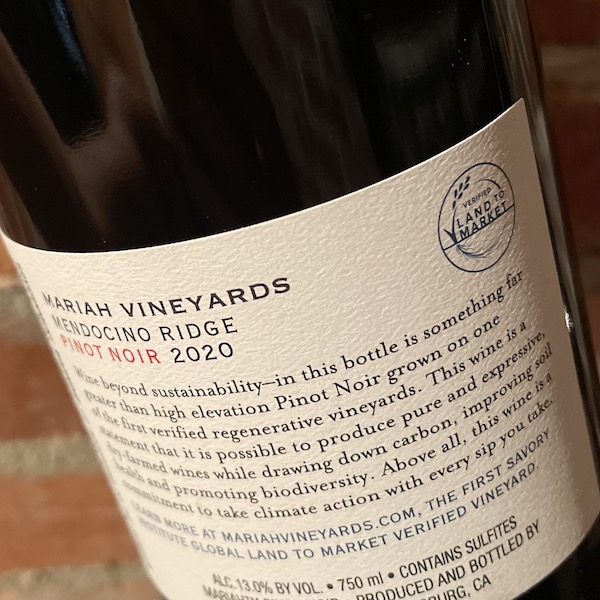
Mariah Vineyards, a holistically managed site in Mendocino, piloted the Ecological Outcome Verification certification in partnership with the Savory Institute. The winery, founded more than 40 years ago by Dan and Vicki Dooling, has been farming sustainably from the beginning, says their daughter Nicole Dooling. She now runs Mariah alongside her husband, Michael Frey.
“We gravitated toward this certification because it is designed to be site-specific,” Nicole explains. “Our vineyard is completely different from a vineyard in Paso or Napa, and it should be considered and farmed differently. Their approach is very science-based. They came here and took soil samples to assess its health and establish a baseline, and they walked the land to see how biodiverse it is.”
Whether certified organic or not, the benefit of Land to Market is that they will work with anyone.
“They’ll absolutely work with conventional farmers,” she says. “I appreciate that they will meet you where you are and show you how you can improve the health of the soil and the entire vineyard. It’s a holistic approach.”
Land to Market Relevancy
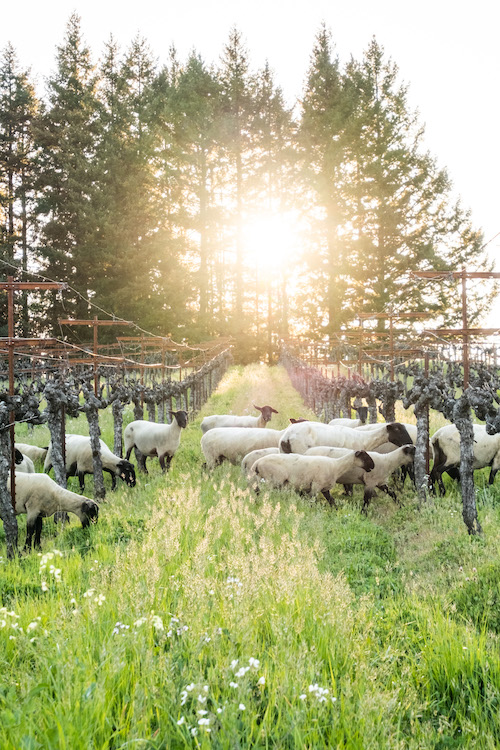
At the vineyard, Frey says their newly implemented regenerative practices include “halting cultivation underneath vines in addition to our existing no-till, dry-farming and cover cropping system. We have integrated planned grazing and increased the biodiversity of our cover crop. We’re also planting insectary and pollinator habitats and continue to forgo synthetic chemicals.”
Land to Market is, Frey explains, the most applicable when compared to other certifications.
“We considered Regenerative Organic Certification, but it wasn’t as relevant to our practices,” says Nicole. “While we do have sheep come in and graze, we don’t have them there year-round. We don’t really have a staff, so the social pillar is relevant.”
Regenerative Organic Certified: Focus on the Land & Community
The Regenerative Organic Alliance founded their certification program in 2017 with the goal—like Land to Market—of creating standards for farmers of all stripes, from commodity crops to clothes.
Troon Vineyards, Tablas Creek, and Fetzer Vineyards are all certified Regenerative Organic. Fetzer began farming organically in 1987 and, in 2000, has been certified Biodynamic on select ranches.
For Fetzer, this certification was part of their ethically-minded and integrated approach to business. (Fetzer is also a B Corp. and Climate Neutral certified).
“ROC aligns with and builds upon our existing approaches to soil health and worker fairness. It connects and supports all 17 of the United Nations’ Sustainable Development Goals (SDGs). This makes a truly comprehensive, rigorous and globally relevant standard,” Jess Baum, director of regenerative development and sustainability at Fetzer Vineyards, said in a public statement after the certification was complete. “Also vitally important is the ROA’s goal to protect the term ‘regenerative’ from greenwashing, which is essential if we can grow adoption of regenerative organic to address the climate crisis and worker and community equity issues that are systemic in our food landscape. Simply put, the wellbeing of people, planet and communities are at stake.”
Biodynamic: A Holistic Approach to Doing Business
Biodynamic farming is arguably the oldest recognized and formalized way to farm sustainably. It was developed in the 1920s by Rudolph Steiner and entails several highly specific practices, many of which have a spiritual element.
For the Hedges family, the spiritual element was part of the draw of biodynamics.
“It’s more than regenerative or organic,” says Sarah Hedges Goedhart, winemaker. “There’s an emotional and spiritual element to practice, and we appreciate that. It doesn’t feel static and follows the rhythms of the earth and land, which makes sense to us.”
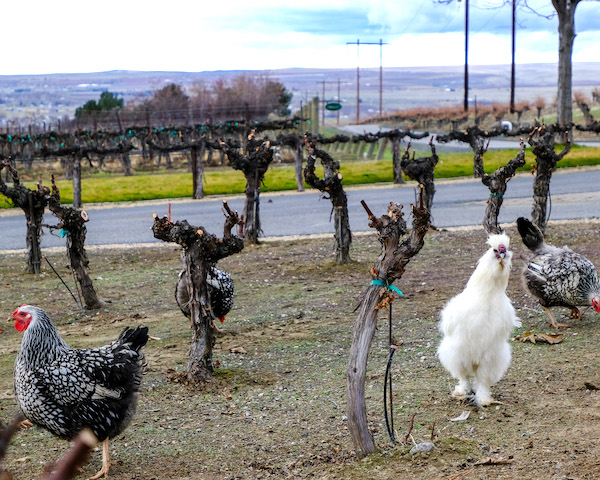
The Hedges also appreciate the animal component. They use chickens to control grape pests like cutworms and weeds, fertilize the soil, and bring a general sense of joy to the estate and vineyard. “Biodynamics is about creating a closed-loop system, so everything you need is sourced on the farm and doesn’t have to be trucked in,” says Goedhart.
Sarah and Christophe are the first to say that biodynamics includes some mysterious elements. However, they also point to the progress science has made in proving many of the previously unsubstantiated claims.
Highly Localized Efforts: Targeted Environmental Approaches
In 2014, about 35% of vineyards were certified environmentally sustainable. Now 65% are, with goals of reaching 100% compliance by 2025. The region leads all French appellations in volume for HEV certification, and organic certification has increased by 30% in recent years. Some appellations are stricter yet: the Bordeaux Superieur AOC is considering limiting chemicals across the board.
But, like many things delicious and French, a one-size-fits-all-approach n’arrive pas.
For Jean-Baptise Cordonnier, co-owner and agronomist at the certified organic Château Anthionic in Moulis-en-Médoc, that means biodiversity on steroids.
Cordonnier is bringing the forest into the vineyard, using strategic plantings of trees and hedges to protect grapes from the extremes of climate change, and remove carbon from the air, he explains.
“Using agroforestry helps us fix carbon and regulate the bioclimate of our vineyard,” he says. “It decreases the effect of heat waves and reduces the impact of frost—which helped in 2017 and 2021 when frost decimated the region. It also helps feed the soils, so we don’t have to introduce inputs.”
And it means he can keep his prized Merlot.
“Merlot is our signature, and it is very vulnerable to climate change,” Cordonnier says. “I don’t want to change my blend. I’m going to add more hedges around the Merlot to shield it even more. This, in turn, improves the vineyard’s health overall.”
Mini Forest, Big Benefits
Estelle Roumage, winemaker at Bordeaux HVE-certified Superieur’s Château Lestrille, prompted by the “crisis” she says she sees in the sharp decline in insect, bird and animal populations, and the ongoing effects climate change to incorporate her own form of agroforestry to the estate.
Roumage has added a fast-growing Miyawaki mini-forest to the estate to soften the ravages of extreme weather in her vineyard. The forest is designed to grow ten times faster, be 100 times more biodiverse, and become 30 times as dense as a forest of conventual plantings.
“By increasing biodiversity and adding cover crops, we’ve alleviated the extremes of climate change,” Roumage says. “But we’ve also improved the quality of the wine. The freshness of flavor is improved, and with deeper roots. We’re growing grapes that are higher in acid with a lower pH.”
Localized Success
Washington state is one of the newest regions to join the move toward hyper-localized sustainability. The newly unveiled Sustainable WA certification program builds on the state’s Vinewise program developed 20 years ago. It’s led by more than 40 growers and vintners who came together to share their challenges and concerns. The emphasis will be on environmental stewardship, sustainable water management and worker health and safety.
Producers are doing their part. Now it’s time for retailers and sommeliers to help tell their stories. Fellow consumers? When selecting a wine to pair with our tacos next Tuesday, perhaps it’s time to prioritize not just variety and region but also the method in which the grapes grow.

 Kathleen Willcox | Somm TV