 Mark Gudgel | Edible Marin & Wine Country
“I get this call a lot,” remarks John Aguirre, in a weary but not unfriendly manner. The president of the California Association of Winegrape Growers, Aguirre is a busy man, trim and slightly grizzled. The call he has taken was to do with how climate change is impacting his industry.
When the Napa and Sonoma Valleys were first planted to grapes, California was nowhere near as warm as it is today. The Environmental Protection Agency estimates that California’s temperatures have increased between 1.5 and 3.5°, on average, over the past century.
“Growers tell me, ‘Yeah, things are different. Winters are warmer, growing seasons are longer, things are happening that are consistent with the effects of climate change—more intense rain periods, flooding, drought, reduced snow pack—it’s a challenge,’” says Aguirre. “But people ask me ‘Are growers changing what they’re growing?’ and the decision is really driven by what wineries will pay for. They aren’t looking 10 or 15 years into the future; the grower has income tied to the vineyard.”
And yet, with the Washington Post running headlines like “Goodbye Cabernet Sauvignon: How Climate Change Will End Wine As We Know It,” and even Bordeaux, arguably the world’s most stringent winegrowing region, conceding to allow growers to plant non-traditional varietals in response to climate change, there can be little doubt that the wine industry is paying attention and understands that it must adapt. What forms that adaptation will take, however, is a point far from agreed upon.
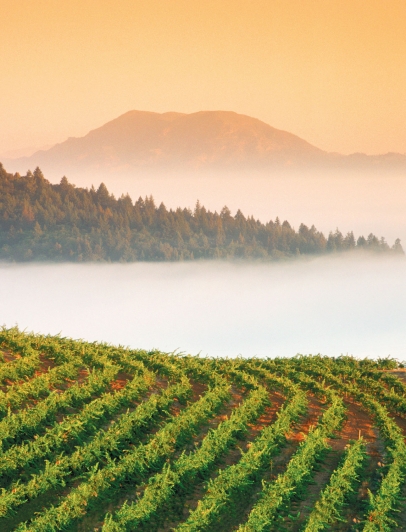
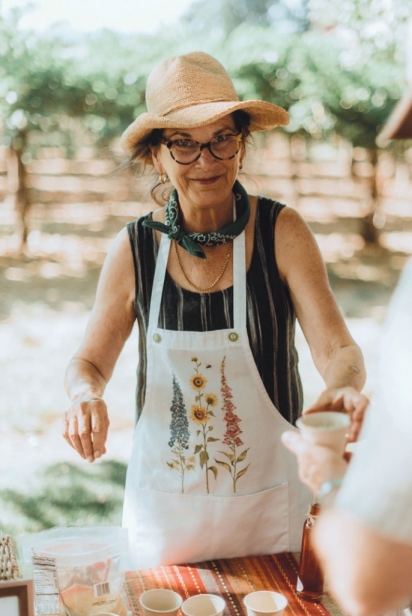
“This morning is blue and satin, sort of peachy, it glows, very surreal,” remarks Julie Johnson, staring at the moon as it drifts over the Mayacamas. Johnson, who founded her winery, Tres Sabores, in 1987, has a passion for Zinfandel, having fallen in love after her first taste of a Ridge Zin in the 1970s. A decade ago, nearly 10% of Napa vineyards grew that varietal, but that figure has decreased to a mere 3% today. Johnson has 10 acres of it planted in Rutherford, an AVA where Cabernet Sauvignon is undeniably king.
Tres Sabores is certified Napa Green and all of Johnson’s vineyards are organic, but her efforts don’t stop there. Johnson’s growing practices include planting cover crops, dry-farming and other earth-friendly approaches that allow her to grow Zinfandel, which is a delicate varietal compared to some, in an increasingly warm valley. For Johnson, adaptation means subtle changes to her already herculean efforts to be conscious of her environs.
“There are a lot of cultural practices that have to change, and we long ago came to a cultural practice—a viticultural practice, of canopy management in what is called an old California sprawl vineyard— which is about the opposite of a vertical trellis. About 20 years ago I put a V-shaped trellis over the top so that the whole vineyard canopy was lifted up and opened. The shoots come over the wires and drift down on the west side to protect the grapes from the late afternoon sun, and I opened it up to the eastern side so that the grapes get the less harsh early morning sun.”
But Johnson realizes that there is a limit to how much climate change can be adapted to, long-term, with trellising practices alone. One solution, she says, is to make wine that reflects Napa’s new climate—and hope that people will buy it. “Will I make a ‘riper’ Zin going forward? I’ve already seen that to some extent, with the seasons getting warmer and the drought years we’ve had.” Johnson, who made the only Zinfandel featured at Premiere Napa Valley last year, has continued to make outstanding wine and wow consumers, despite changes in the weather. Perhaps here, the varietal gives her an advantage.
“A lot of roads point towards varietals like Zinfandel, warm climate varietals, for success long term,” says Johnson, “and I think that’s just fine.”
“We still believe strongly in the resiliency of Cabernet Sauvignon and Sauvignon Blanc,” states winemaker Aron Weinkauf of Spottswoode, but he quickly adds, “We think there are other varietals that also produce great wine over a larger spectrum of temperatures, so are looking at some of them. We are also looking at some hybrids and other varietals.”
Like Johnson, Weinkauf recognizes that things are changing, that adaptation is necessary and—like Tres Sabores—Spottswoode is leading by example. Weinkauf believes that improved practices and a focus on taking care of the land can prolong the existence of Cabernet Sauvignon and other varietals in the Valley, maybe even indefinitely.
Spottswoode has long cultivated a tremendous reputation for producing excellent wines in an earth-friendly manner. When asked about it, Weinkauf gets rather excited: “We have long been working with our environment. Spottswoode has been farming organically since 1985 and biodynamically since 2009. “We’ve worked to restore riparian corridors surrounding the vineyard, and plant a spectrum of plants in insectaries throughout the vineyard. We’ve been working for 10 years on improving our irrigation system, adding variable frequency drives, utilizing plant-based vine-water-use monitoring, which is more precise; utilizing shade cloth; not picking too late; not leafing too much and adjusting some of our cultivation practices.”
For Weinkauf, and Spottswoode, the adaptation started long ago, driven by ethos more than urgency, and today is quite sophisticated. But despite being an undeniable industry leader when it comes to sustainable farming, Weinkauf concedes: “It still feels like there is a lot of room for action and improvement in all of these areas.” How much time is left in which to improve, and what those improvements may need to be, remain points of great uncertainty.
The great reluctance to abandon Cabernet Sauvignon—the love child of Cabernet Franc and Sauvignon Blanc that has for decades been the flagship wine of most producers in Napa and many in Sonoma County, as well—is certainly understandable. Over 20,000 acres of Napa and over 12,000 acres of Sonoma are planted to Cab Sauv, and a vast majority of producers (including the Zinfandel-loving Julie Johnson) craft one or more takes on the varietal. In total, nearly 100,000 acres of California is planted to Cabernet Sauvignon, yet they still command premium prices in the market.
Even the casual observer will note that Cab Sauv often does very well in the cooler mountain climes, with some amazing and heralded Cabernets—Dunn, Smith-Madrone, Volker Eisele Family Estate, Mount Veeder, Pride Mountain and many others—being grown high off the valley floor in both mountain ranges and a wide variety of AVAs. While the Stag’s Leap AVA, the elevation of which ranges from sea level to 400 feet above, gets 30 inches of rain annually and reaches 100° in the summer, the geographically proximate Howell Mountain AVA ranges from 1,400 to 2,600 feet above sea level, gets nearly twice the rainfall and doesn’t get as warm in the summer.
The temperatures in mountain AVAs, such as Howell Mountain, Spring Mountain and Mount Veeder, are often far more moderate than those on the valley floor, while they also tend to benefit from more precipitation. And while this seems at first blush to offer a safeguard against the changing climate, many of those who inhabit the higher-elevation AVAs remain skeptical. “The coastal influence should help us. When the ocean level really rises to flood the Napa Valley, then that should help cool us down!” jokes Randy Dunn, who has made his world-famous Cabernet on Howell Mountain since 1979. Dunn may play at being incredulous, but he is famous in the Napa Valley for leading the charge in protecting the land. “Any prediction that anyone makes is just a crapshoot,” says Dunn on a more serious note. “Only time will tell.”
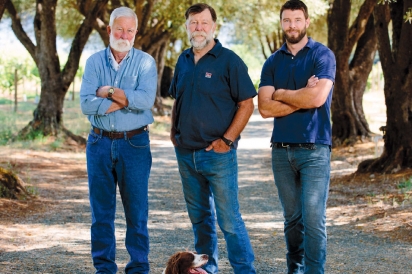
On the other side of the Valley, but not terribly far as the crow flies, atop Spring Mountain, Stu and Charlie Smith have been making wine since 1971. Smith-Madrone produces Cabernet Sauvignon, also Chardonnay, Riesling, a red blend called Cook’s Flat and, recently, a rosé. “One of the things that I find interesting: How are we mere mortals, not scientists, to know if what we read in the newspaper is correct or incorrect?” asks Stu. “You can find anything you want to believe in the newspapers.” Stu, who consumes the New York Times, Napa Valley Register, San Francisco Chronicle and, for good measure, the Wall Street Journal on a daily basis, is perhaps uniquely qualified to say this.
“What I’m not sure of is whether what I’m seeing is climate—or merely weather. I accept that the weather is changing because there are a few things that can be separated with certainty from the cacophony of noise. One is that the glaciers are melting, and two is that, now, after 1,500 years, the English are able to grow wine grapes again.” But beyond England and Antarctica, the Smiths have witnessed dramatic changes in weather during their nearly 50-year tenure in the Napa Valley, as well.
“The winters of ’75–76 and ’76–77, those were the driest on record in the Napa Valley, maybe only 12.5 inches both years. Then in ’98 we had 102 inches of rain up here. I’ve seen temperatures as low as 12 and as high as 114 down on the valley floor. 2009, 2010, 2011—those were the coldest vintages in my memory, and talking with a bunch of people older than me, nobody had seen anything colder…. Andre [Tchelistcheff] did mention one year that they didn’t harvest until December.”
More recently, however, increasing extremes in weather have taken a serious toll. Labor Day weekend of 2017 is burned into the minds of most grape farmers in Wine Country. That weekend, the temperatures reached as high as 114°. The Smiths had already harvested their white grapes, thankfully, but the reds were still on the vine. “We won’t have a 2017 red wine for sale because of it,” says Stu, his voice softening slightly at the edges. Asked if he thought his mountain location might somehow protect him from changes to climate, Stu characteristically sticks to the facts: “We’re cooler; our Cabernet is still a couple inches out right now, while down on the valley floor they’re probably out eight inches, maybe pushing a foot by now. It takes longer for our soils to warm up because we’re up higher and it’s colder.”
Of course, that didn’t save the 2017 vintage. So what adaptations are the Smiths, who have been in business making wine in California just about as long as anybody, now making?
“I am rethinking dry-farming, and I have made a change in the way we farm,” offers Stu. “We don’t have a lot of water—our water supply right now is 11 gallons a minute, but I am going to water with what little I have to make sure my vines can get through the season. Our rainfall last year was 22, maybe 23 inches, from fall to now, and the distribution wasn’t very good. January and February we had virtually no rain.”
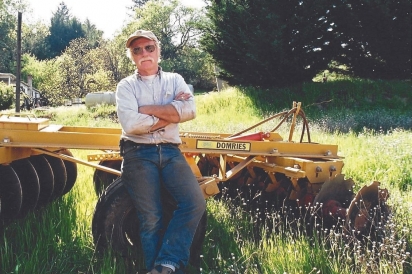
Limited rainfall has the Smiths concerned. “Also this year, in the older vineyards that go across the slope, we’re disking every other row, whereas normally we are non-till. I’m disking one field that hasn’t been cultivated since we re-cultivated in 2000. I’m doing it for two reasons: to minimize the cover crops taking water and, second, we have wildfire issues, so I want a certain amount of firebreak going through my vineyards. Cover crops burn.”
Stu has to get back to his taxes, so he ends by saying: “We’ll be able to get by, but I’m worried.”
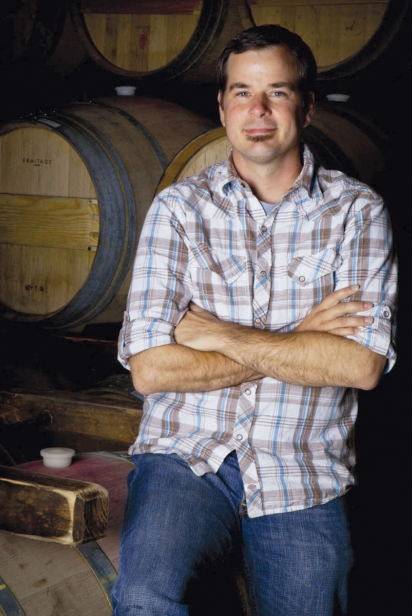
Back down on the valley floor, Dan Petroski at Larkmead has taken another approach. Like Weinkauf and Johnson, Petroski has always been thoughtful about his vineyard practices and how they impact the planet. However, while Larkmead’s small-production Cabernets have earned rave reviews from consumers and command strong prices in the market, Petroski has gained notoriety in recent years for his experimentation with other varietals.
“Zinfandel and Petite Sirah are wildly successful here and do well in warmer climates. We’re bringing some of that back here and I’m super excited,” says Petroski. “We have a history with them here at Larkmead.” Indeed, founded in 1895, Larkmead survived Prohibition by selling grapes and making sacramental wine. Among the earlier wines produced at Larkmead, well before Napa Cab became an international obsession, were other varietals of vinifera including Petite Sirah.
“Don’t tell me that Tempranillo isn’t a world-class grape. If you’ve ever had Vega Sicilia from Spain, you know what I’m talking about,” continues Petroski. There’s only one problem: “I need 20-year-old Tempranillo vines. This is going to take time. Whether it’s me who will be here to do that, I don’t know, but hopefully I leave a plan in place for the next generation.”
He continues, “The funny thing about California is that we’ve tied our existence to European grape varieties, similar to Bordeaux, but it rains all year in Bordeaux, and our rainy season ends in March. Where Cabernet is known in Bordeaux, it rains all season. We don’t have that. I think we’re going to have to adapt and evolve to what climate is going to bring us.”
What makes Petroski so sure this is the right move—sure enough to spend a small fortune on an experiment that likely won’t come to fruition during his tenure at Larkmead?
“I don’t come from a science background; I don’t have a family history of farming. I had a corporate job—the last six years of my life [before coming to make wine] was spent analyzing data and trends, and that’s what I’m doing here.” Planting grape varietals, classic Old World varietals like Tempranillo, yes, and Petite Sirah, but also Aglianico, Touriga Nacional and other lesser-known varietals and clones, is Petroski and Larkmead’s offering to the future.
So where does that leave Cabernet Sauvignon?
“We know more than we did when we started planting Cabernet in Napa Valley,” says Petroski matter-of-factly. “Things have changed a lot. All I’m saying is that the next 25 years won’t be about Cabernet Sauvignon, and that’s pissing a few people off—the whole Valley is planted to Cabernet.”
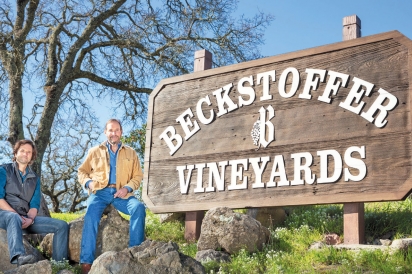
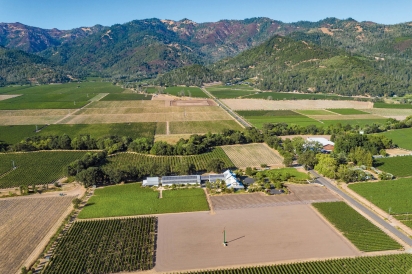
One grower who isn’t at all interested in other grape varietals is Andy Beckstoffer, whose Cabernet vineyards, including To Kalon, are world famous. But not being willing to budge on the varietal doesn’t mean Beckstoffer doesn’t recognize the looming threat of climate change and the need to adapt.
“We’ve been here a little while,” jokes Beckstoffer, who founded Beckstoffer Vineyards in 1970. “When we came here, this was not wine country. The grapes were probably better than the wine. All of that has changed. [Napa went from] 30 wineries to, I don’t know, 300 to 400 brick-and-mortar wineries. There’s a lot of traffic now.”
But 50 years in viticulture have taught Beckstoffer a lot about how to adapt, and changing climate isn’t the first time his oenological livelihood has been threatened, forcing learning and adaptation to take place rapidly. “When we came here we were farmers. We rode tractors and did what we knew,” recalls Beckstoffer. “When Phylloxera hit in the 1980s, we became viticulturalists—and that changed everything.”
The lessons learned from Phylloxera, a vine-destroying louse that ravaged much of Europe’s vineyards in the latter part of the 19th century before mutating to overrun the AxR1 rootstock in Napa in the 1980s, are particularly relevant, and may be what Beckstoffer has in mind as he partners with UC Davis in what, according to Beckstoffer, the university has termed “the mother of all research trials.”
Over the next six to seven years, UC Davis researchers, using Beckstoffer’s vineyards in Lake County, are working with 10 different clones and 10 different rootstocks, for a total of 3,600 different combinations, testing each for its reaction to changing climate conditions, such as drought. To call the project ambitious would be a hyperbolic understatement, but both Beckstoffer and the university, hailed for its world-renowned department of viticulture and enology, seem to believe that, like many that came before this one, the problem of climate change can be addressed with a scientific solution.
In the case of Phylloxera, the scientific solution came in the form of a louse-resistant hybrid rootstock known as 41B. In the case of the rapidly shifting and increasingly erratic climate, Beckstoffer hopes that science will again provide him with an answer—and one more agreeable to his holdings than “plant something else.”
When Northern California’s Wine Country was first planted to fruits, among them grapes, more than a century and a half ago, the problems that farmers and agriculturalists face today would have been nearly impossible to imagine. As Napa, Sonoma, Marin, Mendocino and Lake counties and other large swaths of land evolved into some of the most cultivated and sought-after grape-growing regions in the world, other changes were simultaneously taking place, changes that may today threaten the future of the entire state’s ability to produce the wine that has helped to make it famous.
Whether or not Cabernet Sauvignon, Pinot Noir and Chardonnay— the varietals arguably most responsible for the success of California’s wine industry—will continue to have a future here is yet to be seen. As temperatures fluctuate with increasingly erratic patterns, fires become more frequent, drought more common, there are those who are striving to adapt right alongside the climate. Which adaptations will suffice to protect the vines and preserve the industry, however, is still largely a matter of speculation. What seems more certain is that those who fail to adapt in any way have a finite number of harvests remaining.
As the COVID-19 pandemic continues to cause billions of dollars in damage to the wine industry, it will largely be the small producers, like those interviewed for this story, who will feel the sharpest pains. Their tasting rooms closed and the restaurants and retailers that sell the majority of their wine shuttered, not every winery is destined to survive the pandemic of 2020. It is likely that some will begin to cut corners to reduce costs; innovation and expensive “experimenting” for the future will give way to simply surviving, today.
This may prove the most compelling reason to buy a bottle of Smith- Madrone Riesling, Tres Sabores Zinfandel, Larkmead Cabernet or Spottswoode Sauvignon Blanc. If these producers are going to continue to lead the charge in efforts to adapt to Wine Country’s new climate, they’ll need to stay in business.
About Napa Green: The Napa Green 501c3 is a global leader in sustainable winegrowing, setting the highest bar for sustainability and climate action in the wine industry. Napa Green facilitates whole system soil to bottle certification for wineries and vineyards, and provides the expertise, boots-on-the-ground support, and resources to continually improve. Learn more at https://napagreen.org/participating-members/.
Anna Brittain
Napa Green
+1 805-636-3329
email us here
Visit us on social media:
Facebook
LinkedIn
Instagram