 Pam Strayer | Wine Business Monthly
March 18 marked a landmark day in glass manufacturing’s arc toward climate neutral glass wine bottles. That was the date that Verallia, the world’s third largest glass manufacturer, lit its first all electric furnace, forging its path to lower carbon emissions glass. Electricity will come from renewable sources, said Verallia USA CEO Felix Lamolinerie.
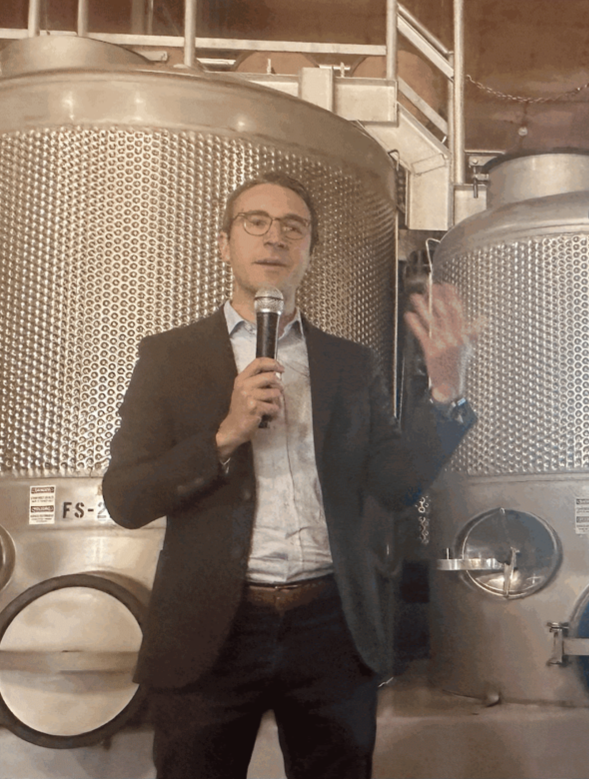
Speaking at Napa Green’s workshop April 26 at Pine Ridge Vineyards, Lamolinerie said the electric furnace represents a breakthrough in the glass industry.
“To run an electric furnace [of this size] has never been done before. It’s the first time a glass manufacturer is doing this for glass containers and on a big scale furnace,” he said. “It’s a big challenge that we are very excited about …we’ll be able to cut our emissions by 60 percent.”
Smaller scale electric furnaces have been used for the pharmaceutical and perfume industry, he said. But in 2022, the company partnered with the Lille-based Fives Group, an international industrial engineering group, to create the larger scale technology. (See video).
“We did several years of R & D. We built the furnace. We lit it on March 18,” he said. “And now it’s starting to run. To control the glass bath with only electricity is actually technically very difficult to do…. And so we’ve been working on that for the last few years. We’re going to be learning and testing as we are launching this technology.”
Speaking in a company video, experts said it is able to produce more than 200 tons of glass per day. Fifty percent of Verallia’s glass production is still wine and sparkling wine bottles.
In addition to the all electric furnace in Cognac, Verallia will also be launching a new hybrid furnace that is 80 percent electric.
“We’re going to be launching them in Spain next year,” said Lamolinerie, who is based in the company’s USA offices in Fairfield. The company said that the hybrid furnace will reduce carbon emissions by 50 percent.
Renewable Energy Sources
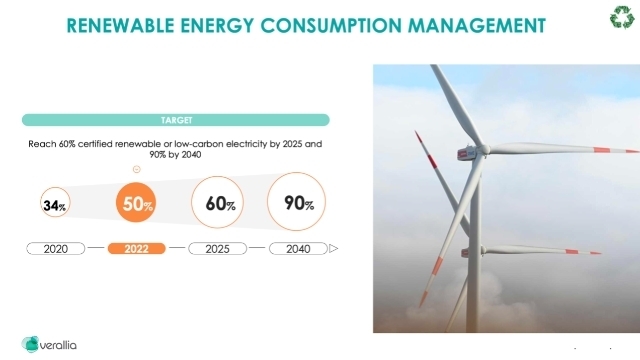
The company uses only renewable energy to power its new electric furnace, Lamolinerie said.
“Another big challenge for us is to make sure that the electricity that we will use to power our plants is coming from low carbon energy. Right now we have Chile, Portugal and Spain that are already 100 percent renewable energy.”
The company recently signed an agreement for energy with Edison Energie to buy green energy from Italy, which includes a new photovoltaic system in Viterbo.
“Germany is known for using a lot of coal in order to power their plants, so we decided not to buy from the grid in this case. Instead we decided to do a partnership with an ultra wind farm that is going to power the energy for us for the next 10 years. And so this is really the idea to get consistent across the board and not just do an action at the level of our furnaces here.”
He continued, “We saw that this industry will have a hard time to survive in the next interesting 50 years and afterwards. We really had to say, ‘Okay, what are the things that we’re going to be doing to make sure that we won’t disrupt completely the way we produce glass?’ That’s really the beauty about volume.”
The vast improvement in lowering carbon emissions in an electric furnace powered glass plant makes imported French wine bottles less carbon intensive than domestic glass made in the U.S., he said.
“The vast majority of the carbon emissions come from the furnace, not the transport,” he said, adding that the company is working on ways to decarbonize transport as well. “We’re working with the shipping line to decrease emissions as well…We are working more and more on boats, and on electric trucks as well. And then we will do that as well to us from the port to the final delivery to the customer. We’d love to do hydrogen electric cars and trucks and all of that.”
Three Prong Approach: Lightweighting, Recycling and the Furnace
While Verallia’s new furnaces are the heavy hitter in reducing carbon emissions, they are just one component in the company’s plan to reduce carbon emissions by 46 percent from 2019 to 2030. Lightweighting and increasing the use of recycled glass are other key parts of the strategy.
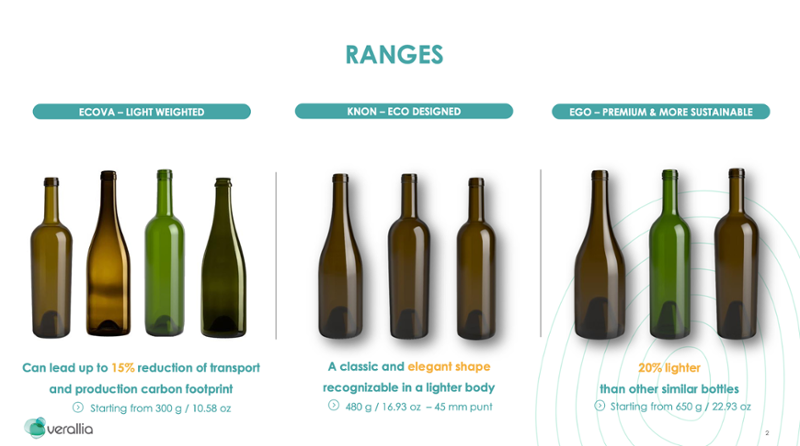
The company’s lightweighting started 15 years ago, Lamolinerie said, and has matured over that period to offer a spectrum of products, including bottles for the toughest category of all–sparkling wines.
“We decided in the past to really focus on the entry level range, and then the midrange, and then the premium range (which is the Eagle range),” Lamolinerie said. In November, Verallia launched its lightest weight Bordelaise Air bottle. It weighs 300 grams.
Domaine Carneros Switches to Lighter Weight Sparkling Wine Bottle
This year, Domaine Carneros in Napa Valley announced it’s reducing its sparkling wine bottle weight from the standard 900 grams to 830 grams–that’s 9 percent lighter–using Verallia’s bottle.
Said Lamolinerie, “We have one factory in Champagne fully dedicated to champagne bottles. They’re making hundreds of millions every year. We have developed technologies and dedicated lines in our furnaces and lines that are doing only champagne.” Verallia also produces charmat bottles for Cava makers in Spain and Prosecco wineries in Italy.
Recycled Glass
The company is also focused on using more recycled glass, but Lamolinerie disputes one competitor’s claim of 100 percent recycled glass, pointing to well known obstacles in collecting cullet from waste streams.
Currently Verallia is using 56 percent recycled glass, on average, but that number varies with the type of glass. “If you look globally or exactly globally,” he said, “Flint is at 33 percent and green is at up to 90 percent. We are investing in a more optimal way to sort the cullet and be able to take any types of collecting and sorting.”
Fanning the Furnace’s New Flames
“The biggest disruption that is going to happen in our industry is the vast majority of the carbon emissions in the glass packaging that are coming from the furnace itself,” Lamolinerie said.
“Our purpose is to reimagine the system for the future…And I really believe it’s a full transformation. There’s a lot of disruption that needs to happen in terms of technology to be able to change the way we produce glass.”
“We’ll be happy to share more insights about what we’re learning about that because it’s really the beginning of the journey here,” he said.