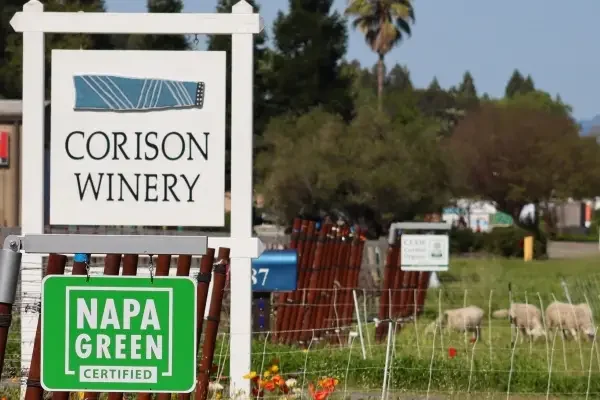
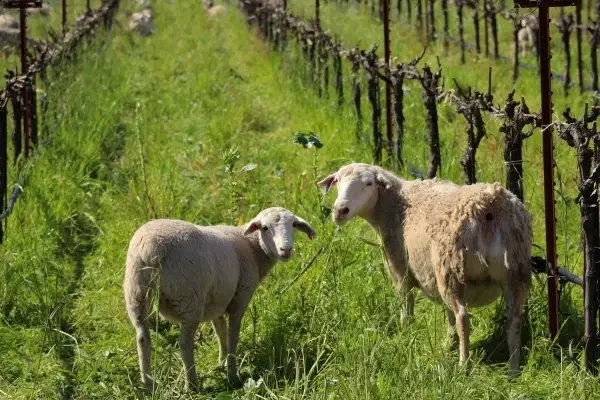
Cathy Corison has long been associated with crafting some of the finest Cabernet Sauvignon in the world but, if you drove down Highway 29 before budbreak, you might have associated the Corison Winery with the view of sheep grazing the vineyard blocks along the highway.
Since the inception of Corison Winery in 1987, Cathy has been a practitioner of and advocate for organic practices. The famed Kronos vineyard on the southern end of the St Helena AVA has been farmed using organic practices from day one in 1995. The majority of the production blocks at Kronos are ‘the gnarly old ladies’- Cabernet vines planted in 1971 that are still in their golden years of production and quality (Happy 55th, ladies!). The vineyard fertility is managed with cover crops and organic compost, and tillage practices are informed by the season- the amount of rain, early heat, and frost potential that might impact the coming vintage’s fruit set and quality.
A couple years back, during Napa Green’s RISE Climate & Wine symposium, we hosted three fundraising dinners to raise money to support direct climate action grants in Napa County. We saw a need in the community to support more innovative projects that standard state and federal grant programs (RIP) were not ready to fund. So, Napa Green raised these funds and put out a call for applications for small (~$5000) Climate Action Matching Grants to jumpstart initiatives at certified vineyards and wineries. Napa Green was able to fund 7 of these projects, one of which was for Corison Winery to start grazing sheep at their Kronos Vineyard.
Grazing sheep in the vineyard is an ancient management technique that has become more commonplace in the last several years. Through numerous studies, including at UC Davis, the grocery list of benefits from introducing sheep in the vineyard has been well-documented if managed correctly. Benefits of grazing sheep in vineyards include: reduced emissions due to less tractor passes for mowing, increased carbon sequestration, increased nutrient availability & cycling, increased soil infiltration, and a proliferation in the diversity of the soil microbiome, leading to healthier, more resilient vines. Sheep grazing in a vineyard has the potential to do more damage than good but all major drawbacks to grazing sheep- such as compaction, vine damage, etc- can be addressed by intentional management of the herd; the detrimental impacts of grazing are not caused by the sheep but by the shepherd.
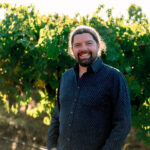
“We just love having sheep here, - it is probably our favorite week of the season. In addition to supporting soil health and structure, they give us natural fertilizer, helping us care for this land for many years to come.”
Grace Corison Martin
Assistant Winemaker, Corison Winery
Through their Climate Action Matching Grant, Napa Green assisted Corison Winery with the funding for grazing in 2024, allowing Corsion to have less risk in a new venture. But, as we have seen in almost every sustainability story we have heard, they saw the benefits and have continued and expanded grazing as a practice in 2025 & 2026. A major factor in the success of grazing sheep in the vineyard is the relationship and management of the shepherd. Corison has had an excellent relationship with Cori Carlson at Napa Pasture Protein over the last two years of grazing.
It is my belief that the main factors a sustainable initiative needs to succeed is: internal motivation, an established support network, and a liiiiittle bit of money. I think we all have the inclination to make the things we can control a little better these days, so let’s all work on building the network to support these initiatives, and Napa Green will do all that we can to find that little bit of money to take the leap.