 Ben Mackie | Champion Story
We’ve gotten used to seeing the flocks of sheep populating the hillsides in Napa as the popularity has made it commonplace in the last few years. And, as a former sheep owner, it warms my heart to see the flocks devouring the cover crops and depositing their contributions in solid and liquid form, nourishing the coming vintage. But last week as I was driving down the Silverado Trail, I was taken by surprise and exclaimed ‘Holy @%&^! Those are cows!’ and immediately pulled over.
Luckily, the cows were in the South Blocks at Rudd Estate, a long time sustainable leader and Napa Green advocate, so I was able to reach out and set up a meeting with Natalie Bath, Winemaker at Rudd, to discuss this surprise in the vineyard.
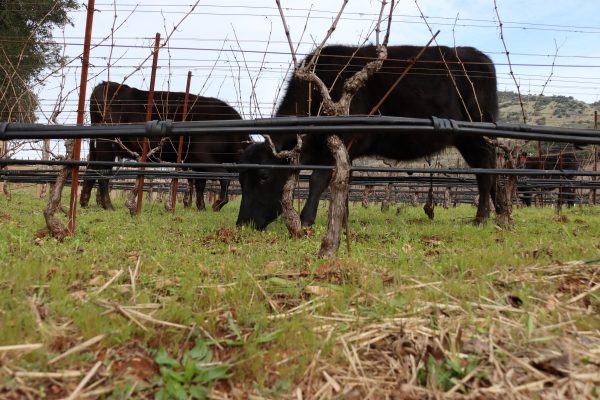
On a frosty, clear morning, I met Natalie along the Oakville Cross Rd. to learn more about cows in the vineyard. I have a long history with cows, stewarding them in various habitats across the country- milk cows, beef cows, even oxen- so I am always excited to see cows or any other livestock in the vineyard. Rudd Estate grazed sheep for several years at both the Rutherford and Mt Veeder vineyards, even owning a small flock for a time. So, when the Rudd team connected with a cattleman up in Knights Valley, they were already primed for grazing, but also looking for a change from the sheep. And there have been more managers talking about grazing cattle in the vineyard, notably Johan Reinke and others in South Africa.
2024 was their first time experimenting with grazing cows in the vineyard. The larger cow herd that these cows come from are mostly half angus, half wagyu, which results in a more slender frame than a full on beef cow, making it more nimble to navigate between the trellis rows. Still, watching the cows on 6’ spacing, the turn radius is pretty tight, so it’s a good thing they are calm animals. And that’s one of the first topics Natalie brought up- their temperament… Cows are just chill. Even cows that are not ‘pets’, not desensitized to the erratic nature of humans, are much less ‘flighty’ or anxious than your standard sheep. Once the cows have been on site for a couple of days, even bordering the Napa County thoroughfares of Silverado Trail and Oakville Cross rd, they are quick to acclimate and fall into the rhythms of the site. But having big animals that could get out of their fences is stressful- Natalie mentioned worrying about it at night- but the block they are currently in has electric fences and a security blanket of a stout, 4’ stone wall.
The morning we visited, the vineyard crew was pruning in the same block as the cows, just a few rows over, and the cows were unbothered, just focused on the fresh cover crop growth. Natalie mentioned how calming the small herd of cows was for the crew, and how much they enjoyed working next to them.
Natalie also discussed how the nutrient composition is different from sheep. Sure, the patties are larger, but the spread of each deposit is similar and the nitrogen content in the cow manure is less ‘hot’. Another common topic of concern folks bring up with any grazer in the vineyard is compaction. This concern has been disproven by some recent studies, including a recent one from the Guadin lab at UC Davis. While the animals certainly impact the soil with their hooves and mass, especially after a rain, there are no long term impacts from the grazing passes, and some growers have mentioned increased water infiltration during intense rain events due to the varied hoof imprints on the top layer of soil. Different soil types are impacted more heavily by grazing animals- clay soils will retain more of the smearing impact by hooves than loams or sands.
During our conversation, Natalie brought up an excellent point about the different ways that cows and sheep graze their meals. Sheep are more likely to use their teeth to nibble on the herbaceous material and eat it right down to the soil surface. For many plants, this can slow, or even prevent regrowth- young plants can be devastated, perennials might have the resources in their root storage and what they can borrow from neighbors, to regenerate, although slowly. When the majority of the ground cover in the vineyard is an annually planted mix, this can set back regrowth and therefore organic matter accumulation, plant exudates feeding the soil microbiome, and carbon storage. Cows, on the other hand, use their dextrous tongue to capture and ingest the plant material, which is less likely to destroy the plants.
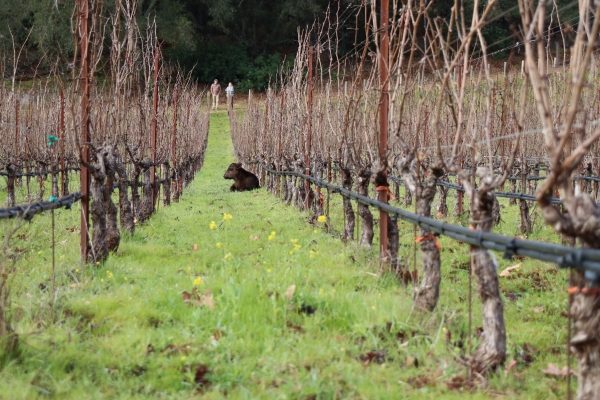
During the conversations with the cattle owner, Natalie’s one request was to not have any cows that might give birth while on the property. While everyone enjoys the joy that a young calf can bring, it can be a stressful time for the mama, as well as the humans that care for her. So, two weeks into the grazing period when Natalie got a call from her nextdoor neighbor that said “well, now you’ve got 5 cows!”, Natalie was surprised. But the calf was born without issue and has been a joyful addition to the stewardship team at Rudd. While the mama was protective at first, as long as the calf is within reach of one of the herd, all is calm and well. Naturally, we wanted some photos of the calf without putting any stress on him or the herd but, as we got closer, he jumped up and ran a couple of rows over to find his mom for a second breakfast of warm milk.
As the sun continues to burn off the dew and frost, the cars and white vineyard trucks speed by on the Trail to the east of the block, and the vineyard stewards methodically prune each vine with care. Unfortunately, we have to get back to our real jobs and, as we are leaving, the calf is basking in the sun full of fresh milk, the cows are slowly, meditatively making their way down their respective vine rows, and I realize what Natalie meant- the cows definitely bring a calming effect to this little piece of the valley.