 Pam Strayer | Wine Industry Advisor
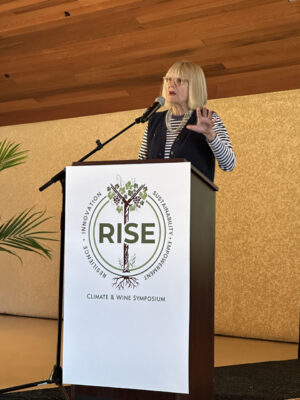
On April 5, 2023, the world’s most famous wine writer, Jancis Robinson, made a rare in-person appearance in St. Helena, Calif., at Napa Green’s Napa Rise sustainability event, highlighting her pet peeves in packaging, green solutions and insights into global wine trends.
Pending anti-greenwashing measures in the EU, reducing carbon emissions in wine packaging and growing more hybrid varieties that reduce the need for fungicides all got her thumbs up. Napa is uniquely positioned to influence consumers and the industry on sustainability, she said, given the high profile visitors and tastemakers it attracts.
“Sustainability is increasingly important…[and it] can attract the interest of younger consumers, too,” she said. “It’s all very well with people as old as me saying it’s important, but then, you know, we know we’ll die before the planet goes up in smoke. But I think the younger you are, the more concerned you are…I don’t have to tell you how important it is that we open up the wine world to as many young people as possible.”
Dirt doesn’t lie
Soon greenwashing may be tempered, she said, with new measures pending in Europe. “I thought you might be interested that the EU recently has submitted a proposal to police claims of sustainability…rather than just letting companies go greenwashing to their heart’s delight, there’s a proposal to actually rap them over the knuckles if they’re promising something that’s not true.”
Robinson said wineries that farm well should educate consumers on what healthy soil looks like. She shared an example from New Zealand’s Quartz Reef where the winemaker presented her with a glass containing a sample of conventionally farmed soil and one from his organically farmed vineyard.
“I don’t know how many of you have actually shown consumers, demonstrating to them what the real difference is between a dead soil and an alive one. And honestly, it’s just such a dramatic contrast and it’s so simple,” she said.
Packaging matters
Known for her strong views on the unsustainability of heavyweight wine bottles — she includes bottle weight in many of her wine reviews and showed the audience her bottle scale — she told the crowd that glass bottles account for “a good 40%” of wine’s carbon emissions.
Her first visit to a glass bottle factory was a revelation, she said. “I was amazed by how hot those furnaces are, and you can’t turn them off. So they have to be kept at 2700°F 24/7, 365 days. And you can imagine how much energy that is using, quite apart from the energy used to transport something as relatively heavy as glass.
“It really is time that we break the connection between heavy glass and wine quality which we know is completely spurious.”
“The last time anyone did any formal research into consumer attitudes to packaging, it suggested that it was mainly neophytes, newly coming to wine, who were impressed by heavy bottles,” she added. “So that’s another thing to get across to the public.”
Lighter weight bottles have become far more attractive, she said. “What’s good today is that lighter bottles are no longer necessarily looking light. There was a time when the lighter bottles looked cheap, but I can tell you in my experience, bottle designs have gotten a lot better and I’m no longer able to guess from the look of a bottle whether it’s going to be light or heavy. And actually I’m getting pretty bad at guessing even lifting it up.”
Cost savings are another reason to switch to lighter bottles, too, she said, citing the example of Tablas Creek Vineyard (Paso Robles, Calif.) which reports that, over a period of 14 years, it saved $2.2 million by using lighter bottles.
The veteran wine critic said that, for her, using non-recyclable packing materials for shipping wine was a deal breaker. “I won’t taste it if it comes in styrofoam,” she said, “because that, of course, goes straight into a landfill.”
She praised cans, bag in box and new recyclable, flat, plastic wine bottles as better alternatives for the majority of wines.
The Napa Rise series continues this month with five more days of experts on additional topics in sustainability.
About Napa Green: The Napa Green 501c3 is a global leader in sustainable winegrowing, setting the highest bar for sustainability and climate action in the wine industry. Napa Green facilitates whole system soil to bottle certification for wineries and vineyards, and provides the expertise, boots-on-the-ground support, and resources to continually improve. Learn more at https://napagreen.org/participating-members/.
Anna Brittain
Napa Green
+1 805-636-3329
email us here
Visit us on social media:
Facebook
LinkedIn
Instagram