Pam Strayer | Wine Business
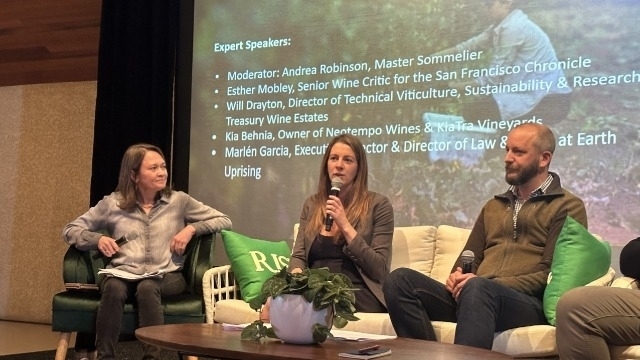
Esther Mobley, senior wine critic at the San Francisco Chronicle, told a St. Helena audience Thursday that the wine industry should message wine’s climate friendly benefits in order to reach Gen Z and Millennial consumers.
Speaking at the final session of Napa Green’s sustainability summit, she said, “The opportunity is to reposition wine as a product that can stand up to climate change, that can maybe mitigate some of its effects. And then, ultimately, it can help us understand the earth better.”
Mobley said consumers “are oblivious” to the fact that wine is agriculture. “Their frame of reference just kind of ends at the supermarket shelf,” she said.
“Many of you in this room are probably here, because you care about the environment, just because it’s the right thing to do…and that’s great,” she said. “But for any of this to work, ultimately, of course, it has to make business sense.”
“I want to make the argument here that it’s really good PR and especially great PR with a cohort of customers that I know many of you would so love to cultivate, which is young people.”
“I won’t go into the basics about how millennials and Gen Z aren’t drinking enough wine…I don’t need to take any time of your day reminding you of that. But I’ll mention a few things that are maybe a little less exhaustively researched in wine circles–which is that young people care really quite a lot about climate change.”
She quoted from a 2021 Pew Research study, that found that younger generations are more motivated by climate issues than their elders.
Sharing the study’s statistics, she noted, “Despite the fact that most forms of political engagement, like voting, are much higher among older people, political action, specifically related to climate change, is significantly higher among Gen Z [age 11-26] and Millennial folks [27-42] than among boomers and older than boomer adults.’
“…the younger someone is, the higher their anxiety is about climate change,” she said, adding that the survey showed “that 41% of Boomer and older generations express anxiety about climate change, compared to Gen X at 46%. Millennials are at 59%, while Gen Z are 69%.”
Party lines did not change the generational split, she said.
“One thing I found interesting was that these effects hold even when you control for political ideology. So Gen Z and Millennial Republicans and Republicans on the whole report less interest in climate change issues. But Gen Z and Millennial Republicans still said that climate change action should be prioritized in much higher shares than older generations of Republicans. These youngsters have ideas that their parents’ generation may not widely share.”
“So, for example, a majority of Gen Z and Millennial people favor the phase out of gasoline powered vehicles by the year 2035. And a majority of generations older oppose that. So, in other words, a customer base that I think the American wine industry so dearly loves has very clear, identifiable priorities and values. And that’s an opportunity.”
“And yet, I do not think, from where I’ve stood, that the wine industry has done an effective job of communicating where it stands on climate change.” She attributed that failing to division within the industry itself.
“What I am suggesting is that the industry as a whole needs to get its story straight,” she said. “You already have incredible infrastructure here, you have very well resourced organizations…[yet] for many casual wine drinkers, or would be wine drinkers, the link between a bottle of Cabernet on the shelf and questions like carbon sequestration are not immediately clear. …Now’s the time for you all to tell a story.”
“I don’t think people have a negative impression of wine, when it comes to climate change. Wine isn’t like Monsanto. I just don’t think people have much of an impression at all. So I think it’s time to make an impression,” she said.
In response to discussions about bottle weight, a metric many wineries are now focusing on to reduce their carbon emissions, Mobley said consumers don’t want big glass bottles. “They’re annoying to deal with,” she said. “And if you’re trying to transport them to dinner, they’re so obnoxious.” She said she doesn’t perceive a reluctance to embrace alternative packaging.
“Wine isn’t like Monsanto. I just don’t think people have much of an impression at all. So I think it’s time to make an impression,” she said.
Mobley shared some of the challenges she’s asked to balance in writing about climate change in her own work.
“One really sad moment for me in the last year of my life is that we have this audience team at the Chronicle that’s in charge of figuring out how to get more people to read our stories. And they said, ‘You have climate changes in two major headlines, Esther. And it’s like a downer day.’”
“So we’re coming up with different ways in the headline to get people to read about this stuff…I think you do have to kind of make it fun and playful or like sexy in a way.”
She said she looks for stories that demonstrate how the industry is adapting to climate change and other issues.
“What I find interesting is trying to talk to people about what are the kind of specific challenges they face in their sites and in their microclimates. And that can often open up interesting stories to me. Let me know if any of you have. If there’s some unique disease pressure, or some unique kind of climate phenomenon you’re experiencing, and you’re finding some way to kind of combat that and mitigate that, whether it’s with something you’re codifying through certification or not, that I think becomes really interesting and helps me understand how the California wine industry is facing climate change, and how California is facing climate change, which is what I’m ultimately interested in.
Mobley said that helping consumers shop their climate change values is a long term proposition.
“Think about how ‘organic wine’ used to be this really weird thing that people have this really bad impression of. don’t think that’s true anymore. I don’t think people associate it with weird wine anymore. And I think that’s happened maybe over the course of like 15 years.”
“And I think the same can be true of a lot of this stuff. I think people somehow over time when people think about Napa, when people think about wine, people think about California wine, they need to imagine a lush, biologically diverse ecosystem that needs to be the underlying association with it. I don’t think you do that overnight.”
“It’s in the small ways that you all talk to your customers, the ways you present your wines when people come to visit you, the message that your packaging sends when it goes out into the world and into restaurants. And it’s a kind of incremental effect.”
“I know that you all have neighbors out there who just can’t really see how climate change friendly farming is going to work with their vineyard yields, who fear that moving to lightweight glass bottles is going to diminish their customers’ perceptions of their wines,” she said, adding a warning “that the surviving generations of customers just won’t want to buy your product if you don’t align yourself with their values.”
“The point is that wine doesn’t have to change to adapt to what the market wants. It already is what people want. And it’s only the fault of the industry for not communicating that effectively.”
About Napa Green: The Napa Green 501c3 is a global leader in sustainable winegrowing, setting the highest bar for sustainability and climate action in the wine industry. Napa Green facilitates whole system soil to bottle certification for wineries and vineyards, and provides the expertise, boots-on-the-ground support, and resources to continually improve. Learn more at https://napagreen.org/participating-members/.
Anna Brittain
Napa Green
+1 805-636-3329
email us here
Visit us on social media:
Facebook
LinkedIn
Instagram
We all know that sheep are the cutest but why are they in so many vineyards?
Cori Carlson, owner of @napapastureprotein shared the ecological goals of grazing a vineyard, along with this one key takeaway at our recent @napagreen workshop.
🐑 🐑 🐑
#woolyweeders #regenerativevineyard #soilhealth
Join us on April 9, 2026 @charleskrugwinery to explore climate smart opportunities, sustainable glass, closures and more ways to green your supply chain.
We will share case studies, hear about climate-smart and alternative packaging, clarify what materials are truly recyclable, and identify new ways to divert more waste from the landfill.
With speakers from Verallia, @naturalcorkcouncil, @cork_supply, Treasury Wine Estates, @freeflowwines, @revinobottles, @keystonecapsules, Wine Industry Zero Waste Collective, @naparecycling and more!
➡️ ticket link in bio!
#winebusiness #wineindustry #supplychainmanagement
Discover four exceptional wineries united by a commitment to sustainability, community, and thoughtful hospitality.
These wineries are not only @napagreen certified but also @bcorporation certified, and through their “B Collaborative” partnership this month, they are offering a special tasting experience: wine club members receive two complimentary tastings, and non-members can enjoy a two-for-one tasting.
Learn More by visiting these wineries.
@artesawinery
@cliffamily
@spottswoodewinery
@troisnoixwine
#winetasting #visitnapavalley
Learn why Natalie Bath, Winemaker at @ruddestate considers @napagreen an important part of their commitment of land stewardship.
#SoilHealth #WomenInWine #RegenerativeViticulture
@napagreen has had a number of growers looking for organic solutions to dealing with nematodes where vines are planted. Our partners at @lallemandplantcareusa have an OMRI approved biological solution.
Learn more in this short video!
#soilhealth #vineyardmanagement #wineindustry
Join us March 17th @grgichhillsestate to connect with cover crop expert Keith Berns, with @greencoverseed, and experienced viticulturists, to leans how you can incorporate soil health practices in your vineyard!
➡️ Registration link in bio.
#soilhealth #regenerativevineyard #covercrop
What is biochar and why is it so cool?
Hear from @napa.char to learn more.
#climateaction #soilhealth #biochar
🐝 “If you build it, they will hum” - Erin Arnsteen, Western Program Coordinator @monarchjointventure
We are grateful for everyone who attended our Biodiversity in the Vineyard workshop last week! It was an amazing day @grgichhillsestate filled with bees, birds, butterflies, a community passionate about biodiversity, and experts providing resources for building biodiversity in YOUR vineyard.
#regenerativeag #biodiversity #worldwildlife #regenerativeviticulture
Join us in congratulating Megan Scott (@love.dream.breathe), our Operations Director, on 6 years at @napagreen. Megan’s positive attitude and “can do” approach to problem solving has greatly contributed to the success of Napa Green and our members.
Thanks for your work and dedication to sustainability!
📸 @brianamarieweddings
📍 @trefethenfamily
#womeninwine #womeninstem #climateaction
Thanks to the @naparegister for publishing this Climate Connection contribution from @napagreen’s Vineyard Program Director, Ben Mackie (@soilrainandhope) highlighting the biodiversity @grgichhillsestate.
If you loved this article, you’ll love our Birds, Bees & Butterflies: Biodiversity in the Vineyard workshop happening today!
#climateaction #regenerativeag #regenerativeviticulture
Friday night dinner dilemma?
Order takeout from @southsidenapa using promo code DONATE and 20% of your order will be donated to @napagreen.
It’s a win: win! You get dinner and @napagreen gets funding to contribute our impactful climate action work in Napa Valley.
Order online or preorder your Fried Chicken Friday pickup for February 27, 2026. Don’t forget to pair it with Napa Green certified wine! 🍽️ 🍷
#dineanddonate #nonprofit #napavalley
Join us Thursday, February 26 to learn about biodiversity in the vineyard.
🍇 Ivo Jeramaz, Winemaker & VP of Vineyards and Production at @grgichhillsestate, will welcome us to the beautiful property and illustrate the various implementation of habitat diversity they have undertaken at the American Canyon ranch.
🍇 Jo Ann Baumgartner & Sam Earnshaw from @wildfarmalliance will provide insight on how to maximize bird habitat and establish hedgerows to support the local ecology.
🍇 Erin Arnsteen from the @monarchjointventure will outline how pivotal vineyard acreage can be to support the dwindling Western Monarch populations.
🍇 Cori Carlson, owner of @napapastureprotein, will explain the ecological goals of grazing a vineyard.
🍇 Ruby Stahel from the @naparcd will join us to discuss the various resources that the RCD has to support habitat enhancement on Napa properties.
🍇 @soilrainandhope from @napagreen will talk about bees!
➡️ Ticket link in bio.
#biodiversity #regenerativeag #regenerativeviticulture
Learn about the herd of cattle calmly grazing the vineyards @ruddestate, contributing to soil health and biodiversity, in our latest post from @soilrainandhope.
➡️ Link in bio.
#climateaction #regenerativeag #regnerativeviticulture #soilhealth
Thanks to @naparegister and @kcuz for this great article about the @regenerativeviticulture and @napagreen #OneBlockChallenge field day @celaniwines.
We had a great time engaging with attendees about opportunities to implement regenerative practices in their vineyards!
If you’re regenerative curious or want to learn more head to the link in our bio!
#climateaction #regenerativeviticulture
Congratulations on @napagreen Vineyard Certification to @shadybrookestatewinery!
Nestled in the picturesque heart of Coombsville, Shadybrook Estate, has shown a deep commitment to regenerative viticulture and climate action. Visit to see the natural beauty of this hidden gem.
#climateaction #regenerativeviticulture #napagreen
We love the biodiversity in this @grgichhillsestate American Canyon Vineyard!
Come learn how to integrate biodiversity in your vineyard on February 26 at this workshop with @napagreen, @grgichhillsestate, @wildfarmalliance, @monarchjointventure, @napapastureprotein and @naparcd.
➡️ Ticket link in bio.
#Biodiversity #RegenerativeAg #RegenerativeViticulture